This project was a heavier lift than I expected with all the things I realized I hadn’t processed since I hung up my college boots. None of those cogs wouldn’t have gotten turning if it wasn’t for Jen Sinkler really pushing me to write something for Ferine Mag. “Forgive the Keeper” was really the opening for this whole project. Jen, thank you for being my editor, a willing and open ear who allows me to be me, for pushing me to be more mindful of word choice, and for being someone who gets it when I speak in spirals.
Thank you to the extremely talented artists who rolled with me on illustrating the stories: Maya Winters and Anna-Laura Sullivan. Y’all have creative vision that I highly admire and I’m grateful that you shared your skills with me.
COREY MILLER! You saved me hours of editing audio. You did so with great efficiency and attention to detail. You made everything sound so amazing.
Thank you to the women of Equal Playing Field and the Equality Leagues (namely Mara Gubuan and Minky Worden) for taking me under your wing during France and even before then. I so appreciated your hospitality, your guidance, and belief in me throughout our time in France and NYC.
Thank you to Susie Petruccelli for housing me in Lyon for a bit and also for letting me into your world by seeing an early manuscript of your book. You writing so openly and honestly inspired me to write without abandon.
Thank you to all the humans of Dyke Soccer for creating a loving space for me to redefine my relationship with the sport in community.
Thank you Maya Jackson-Gibson, Zoe Jackson-Gibson, Jenna Kesselring, Erica Smith, Pam Kosanke, and others for letting me bounce ideas off you for insight and feedback.
Much gratitude to my wife Magdalene, who always pushes me to advocate for myself and other BIPOC queer women like me. I love you.
Props to my parents who did all that they could to let me have the best soccer career a girl could wish for.
And thank you to all who have read/listened to/and shared anything that I’ve written. I really appreciate your presence. Always.
On our final audio episode of Here for the Long Ball I share the conversation I had with trailblazing FIFA referee Kate Jacewicz. She was the first woman to ref in the A-League, which is the highest-level of pro men’s soccer in Australia. We met at the 2015 World Cup as soccer fans and I was super excited to see her realize one of her dreams of reffing a World Cup in 2019. I talked to her right after the tournament was over and through Kate, I got a behind-the-scenes understanding of what it’s actually like to become a ref at that level, what goes through their minds when they are on the pitch, how fit they have to be, and how VAR actually works (it’s fascinating and frustrating!!!). Check it out.
To get updated on new content, sign up for the email list or follow me on Instagram, Twitter, or Facebook. And consider making a donation! the money goes to support all of the artists and creatives making the magic happen.We so appreciate you <3.
When we think of leaders…why don’t we think of ourselves? Maybe because our cultural understanding of leadership has omitted far too many of us for far too long…. The picture of leadership is not just a man at the head of the table. It’s also every woman who is allowing her own voice to guide her life and the lives of those she cares about. -Abby Wambach
Security at the Madrid Barajas International Airport did not have the technology to detect it at the time, but on July 8th, 2019, an imposter was making her way through the line at baggage screening. She was getting away with a ridiculous crime — an offense that could only be detected on a telepathic level and exclusively punished by a raging inner critic.
I knew this imposter well.
She’s the part of me who comes alive anytime I think of saying “yes” to something that seems way out of my league. That day, it was her clammy palms glomming onto my luggage.
I was flying back from France to New York City after having watched the U.S. win the Women’s World Cup. I was scrolling through my phone when I got an email I was ready to dump into spam. It was from Good Day NY, a morning show on the FOX 5 network:
“Hi Adele – how are you?
I got your info from our Sports Reporter Jennifer Williams. Would you be available to come in as an expert on Wednesday and talk to our anchors live throughout our coverage of the [U.S. Women’s National Team] Championship Parade?”
I froze. My brain spun trying to piece things together because I didn’t remember signing up to cohost a television program! Jen had Tweeted me a month ago about maybe providing a comment or two throughout the tournament and they had never reached out. But this?
Oh no…I don’t think so…
The no-good imposter: I could feel her nervous heart throbbing in my thumbs as they hovered over the keys. She wanted to tell them that Jen got the wrong Adele. That the woman who sings about heartbreak and setting rain on fire would be a better pick. At least she’s used to live TV.
But someone like me? Hello! I’m no sports broadcaster. I hide behind pens and editors for a reason. Ask me about tactics or any legal details about equal pay in real time and I’ll probably say something so dumbbass Twitter would chop me up with a hashtag.
In that case, wouldn’t they rather at least be dazzled by a star? By someone or by people with bling so bright and hair gel so shiny they could only be from the cast of Jersey Shore?
In part, “yes.”
Two days after I received that email, my now-wife, Magdalene, and I were sitting backstage at FOX 5’s NYC studios with DJ Pauly D, JWoww and the rest of the crew. I found it ironic that I was in the same room with the people who taught America how to identify a grenade (nope, not what you’re thinking) when I felt like I was about to bomb.
I watched each of them primp up before their segment on the upcoming season of Jersey Shore Family Vacation as I nommed a bagel and sweated insecurity out my armpits. Once they went, it meant I was next.
Besides my cinnamon raisin delight, there were four things that were anchoring me in this moment:
My navy blue bowtie. My only bowtie. My loving tribute to my fluid masculinity;
My bright yellow nails that reminded me of sweet summer lemonades and Beyoncé;
Magdalene’s soft, warm hands that guided me to get the manicure in the first place, and that took off work that morning to hold me, tether me to this earth; and
A white man by the name of Glenn Brooks.
Thank God for Glenn Brooks (you go, Glenn Brooks!) for he was also going to be a guest commentator with me, and that meant I wasn’t alone. And Glenn was a pro: a radio show host for New York City Football Club (NYCFC), and not to mention Carli Lloyd’s former college coach at Rutgers. In fact, we were surprised when we realized he was still coaching the Scarlet Knights when I played against them for Yale. It was a 0-1 loss that had me grumbling for days.
Oh, Glenn remembered that goal alright. That damn curveball that floated over my fingers and into the net just minutes before the final whistle. A snide smirk crawled across his face as he recalled. I wanted to smack it off and then etch it in stone because somehow it told me: “Relax, kid. You belong.”
Soon, an assistant called for us to follow them to the stage. I sat in my chair at a long table labeled “Parade of Champions” in navy and gold, which oddly matched my outfit. Hosts Rosanna and Lori sat to my right and smiled at me, already glowing for showtime, already expecting the best. 1. 2. 3. And we were LIVE!
The lights were bright and my face was hot. Brown. Incapable of showing blush or the rush of “why me’s?’ still running in my head. It wasn’t until Rosanna and Lori began asking me questions that things became really clear. My reason for being in that seat.
These TV people didn’t want me there to be an analyst like Julie Foudy — that was Glenn’s role. I was there to be me: A human navigating the nuances of sport and identity. Why couldn’t I see that? Why was it so hard for me to settle into my skin and get comfortable being acknowledged?
I think Rosanna began to tug that answer out of me with this question:
“Adele, I know that personally this team means something to you,” she said. “What does [this parade] mean to you?”
In that moment, I only had the time and the level of consciousness to toss her a nutshell, but here I crack it open to show you the heart.
I am a queer woman who didn’t understand she was anything other than straight until she was 21. I grew up in schools and team cultures where there were few gay women. All of them were made fun of, ridiculed, and bullied. I ingrained these ideas that being different in this way was unsafe, un-Black, contra-Caribbean, and potentially a sign of a psychological disorder. In a paradoxical contortion of self-preservation, I had to reject myself before I even knew who I was. Subconsciously, I could not allow myself to see me, let alone be seen by others.
It was safer to be herd than to be heard.
Perhaps that began to change around the time I started following U.S. Soccer’s Studio 90 on YouTube. I loved watching the behind-the-scenes interviews with the players and watching their antics on the road. Back then, no one was talking about their sexuality, being “out,” or anything. But these players were laugh-out-loud silly and so real. I mean they somehow made shopping at souvenir shops one of the funniest things ever. Either that or I’m an easy laugh.
Regardless, there was something so free about the players, particularly Megan Rapinoe and Lori Lindsey, that really drew me in. I wanted to feel more like them and as I leaned more into that space, I discovered who I was in various aspects of my life. At some point, I began to feel more secure in that being. Proud of it.
At the same time, more and more women athletes were gaining prominence, “coming out,” sharing their culture, their identity, their uniqueness, their politics. I fell into sports journalism and started writing stories about athletes of all genders living their truths. I loved my work and the people I met.
I now believe that my job was a natural extension of this liberation that was blossoming within, setting roots without and reigning me, even if by a thread, to kin who are finding ways to thrive at the edges of society’s norms.
And eventually, at 28 years of age, I arrived in front of a camera wearing my suit and bowtie to be broadcasted to thousands of people all over the world — broadcasted so far that even my future brother-in-law stationed in Afghanistan was watching.
This could’ve happened for any other reason. But part of me couldn’t help but think that if those 23 unapologetically determined, loudly unique women, didn’t come together and amplify each other to achieve such success not just in their sport but culturally and politically…if that didn’t happen, oh-so-queer me wouldn’t have been on daytime TV, chatting it up with Rosanna and Lori.
When I left FOX 5’s studios, I texted Jen thanking her for the opportunity. She received the thanks with a bit of surprise because she never submitted my name to be one of the hosts — at least not intentionally. During the show, she was reporting live from the street and when she heard my voice coming from the studio, she was shocked to hear me speaking.
To this day, this is still a miraculous mystery to me.
There’s no doubt in my mind that when the USWNT won the 2019 World Cup they created a wave not fully understanding whose shores the ripples would lap, shape, and elevate.
So often we talk about successful women athletes being such great role models for young girls everywhere. (“And young boys, too!” is a more recent add-on.) I’ve heard it time and time again, especially after every women’s World Cup I’ve been alive for, because it’s true.
The current success of the USWNT and the successes of the women who came before them have paved the way for many of us. This is so true — and yet, this also makes me yawn.
Because to me it repeats this idea that individual and collective evolution is exclusively linear in this top-down timeline. It’s a narrative that excludes us non-whipper-snappers and has us believing we can’t learn from those whose knees don’t yet creak. It makes kids believe they don’t have anything to share with their elders and that outer authority dictates everything.
If I learned anything from my brief moment on Good Day NY, is that we are all mirrors of each other, and when other people — especially marginalized people — lead from their authentic brilliance, something within invites all of us to remember our truth and expand in it. The effects can be intergenerational, intragenerational, vertically, and laterally within various communities.
If there’s anything I’ve learned from coming out, it’s that my family will never be the same. Hard lessons have been learned; new ways of loving have been discovered. I’ve changed and so have Mom and Dad. Our legacies have been born anew.
When I think about the ways in which we influenced each other at the time — when I really think about what that felt like — I envision a stone plopping into still water creating ripples that concentrically flow away from the center. Or sometimes: a stone flying at a pane of glass, sending cracks in seemingly chaotic directions, not one piece unaffected.
Whether it’s in conflict or harmony I try to ask myself, “If we are all reflections of one another, which parts of ourselves are we teaching each other to love?” We all have a part. We all have a light to shed on something.
I’m tickled by a concept I learned recently from my brilliant friend Dakota (Cody) McCoy, who has a Ph.D. in organismic and evolutionary biology from Harvard. (No big.) It’s called convergent evolution and to explain it simply, this occurs when organisms that are not closely related evolve similar traits to adapt to similar environments or ecological niches.
During her dissertation defense, Cody used the example of the bird of paradise and the peacock spider. The male organisms of both of these species are beautiful creatures with vibrant colors that are impossible to ignore. They use their colors to catch the eye of potential mates during their mating dance.
To better their chances of attracting a lover, both of these species evolved so that their black hairs or feathers surrounding the colorful ones appear blacker than black. On a microscopic level, Cody has found that the structure of each black hair or feather traps more of the sunlight than, say, the cotton of a black t-shirt would, creating an insane contrast with the other colors. So the reason why these creatures are so alluring isn’t because their hair or feathers have more pigment. They’ve created this optical illusion that makes their colors really pop.
Now, with my degree in magazines, I know that when it comes to humans, “evolution” is subjective. It also doesn’t impact everyone in the same way due to socioeconomic, racial, cultural, and gendered reasons (among many other angles of intersection); I know there are many times we regress and that even “regression” can be up to perspective.
But I still hold this fantasy that many of us are learning to trap our own light just like the birds of paradise and the peacock spiders. Not by becoming “more” or changing who we inherently are, but by celebrating together in the wisdom that norms aren’t our North Star.
And what of your shadows, my dear?
The ones that make up the other parts of your universe?
Yes, those.
The so-called “dark” matter that takes up so much space?
-a tremble
As if I didn’t get enough footy in 2019, my World Cup summer came to a close with a trip up to Rhinebeck, NY, to see U.S. soccer legend Abby Wambach and her wife, New York Times–best-selling author Glennon Doyle.
My former coworker, Chris, who knew my passion for the U.S. women’s national team and my at-times-cheesy bent for all things self-help, had just started working at the Omega Institute, where the couple was hosting a weekend workshop called “Find Your Truest Life.” Chris insisted I come.
While I was a bit burnt out from women’s empowerment conferences, I couldn’t say “no” when my colleague graciously offered to let me stay at her house in the beautiful quiet of the Hudson Valley. Plus, I was curious to see Abby play a different role than I’d ever seen: leading primarily from the stage and with the love of her life.
When I got to Omega’s campus, nestled in the woods of Rhinebeck, I felt like I had arrived at an adult hippie summer camp. Cabins dotted the hills as dirt paths snaked through lawns and gardens. Long Pond Lake bloomed a menacing green, telling us it was unsafe to swim due to the toxic algae. Still, we campers had access to basketball and tennis courts, as well as a dining hall that served almond milk and granola.
The amenities and the workshop theme matched my expectations of the other camp-goers: a delightful mix of queer soccer fans and women I’d imagined watched Eat, Pray, Love a number of times. Most of these people were white. In the main hall, I took a seat midway from the stage, both excited and sad — disappointed that people who look like me often don’t get the opportunity or even feel safe and supported in places like this.
Soon Abby and Glennon walked onto the stage and welcomed us with an inspiring word. They told us we were there to do the deep work of unlearning all of the false memos we’ve been given about what it means to be a “good” partner, a “good” woman, a “good” human, and discover what we wanted for ourselves. This was going to be the beginning of living through imagination rather than indoctrination.
I smiled because Abby and Glennon, in all their seriousness, were a fabulous comic duo who could often find the softness in hitting hard topics. Like the sea that foams when it crashes against rock, A and G ebbed and joked; the audience bubbled with laughter. They then put on a poppy P!nk ballad called “I Am Here” and invited us all to dance.
As much as I loved all of this cheese, and as much as I clapped to the tambourine, I was intolerant to some sort of discordance that beat within my chest. This subtle rap, tat-ta-tatting remorse code like:
“I am here
As usual, a minority.
Smiling and joking
My way through that oddity.”
It rapped as I bounced, chuckling and videotaping all of the women without rhythm, eventually noticing that I wasn’t alone. I paused and observed the Black women standing rather still in one of the back rows. I wondered how they were feeling, if they were feeling that dissonance, and whether or not they liked P!nk.
It didn’t feel like the moment to ask.
Early the next morning — before our next gathering — I fell into a more comfortable cadence, sprinting through the trees, cracking twigs beneath my feet, jumping over root and rock, breathing in dew, huffing out thought.
I was running behind Abby on her morning trail run with some other campers. We were “the wolves” chasing some primitive connection — the kind that unearths when you work out in a group.
As we ran in silence, I thought about how amazing it was to be sweating with someone I had to crane my neck to look up to as a kid: one of the highest international goal scorers of all time was now humbled enough to have me at her heels. Or perhaps “inspired” is a better word.
I say that because of what she wrote in her most recent book, Wolfpack:
“Throughout my life, my wolfpack was my soccer team.”
(Wolves working together to win World Cups and Olympic medals.)
“Now my Wolfpack is All Women Everywhere…Women—who are feared by many to be a threat to our system—will become our society’s salvation.”
To her we were like the wolves returning to Yellowstone, rebalancing the ecosystem, snuffing out the patriarchy. But in order to make real change, we had to establish “a collective heartbeat,” she wrote. A unifying structure.
This rhetoric echoed what I’ve heard and read in many spiritual teachings that speak of a “oneness consciousness” that will foster a harmonious world that truly honors diversity.
But which tectonic shifts of mind — of heart — need to happen before the return to Pangea?
Which earthquakes, what rumblings, which reckonings?
For all of us to embody the fact that we are all connected, that “we are all One,” we must first acknowledge how long we’ve been practicing the opposite through body-based discrimination and oppression.
As I ran, I thought about the soil beneath my soles…how in order to move forward I needed to know the present ground below.
In the main hall, the grumble was subtle, ignorable, but palpable if you chose to pay attention: the uncomfortable coughs, the agreeing nods, the shifting in the seats. Some things were stirring, rocking. Processing. Either being broken down or resisting.
Racial justice activist Austin Channing Brown was now on stage — the epicenter. Everyone knew she was going to be one of the guest teachers for the weekend, but I don’t think most signed up for what they were about to hear. If they had read the first sentence of her book, I’m Still Here: Black Dignity in a World Made for Whiteness, would they have been sitting in those seats? “White people are exhausting,” she wrote. When I read that I laughed, recognizing that feeling — the one that I’ve swallowed many times, slightly relieved in a chuckle.
This time Austin, who stood before a room of (basically) white women, didn’t start off with humor but vulnerability. She shared how much energy it took for her to come to Omega. How unsafe she felt sometimes to talk truthfully about race with white people and the risks that come with it.
I was in complete awe of her strength because I’ve known this fear of being labeled “divisive, negative, and toxic,” as Austin has described in her book. I mean, I can’t remember a single time I’ve spoken up against systematic racial oppression out loud in front of a group of white strangers.
(Remember I tend to hide behind pen and paper.)
Instead, I’ve watched my Black friends bring it up and get the following responses:
“I get it. I’m not racist. I don’t even see color.”
(Does that make my pain and that of my ancestors invisible?)
“I know this is so horrible. Sending you love and light.”
(Light also casts shadows. What if the solutions are in the silhouettes? And what if we don’t like it?)
Frankly, we don’t need to. And…
“I don’t need you to like me,” Austin said on stage. “I need you to see the system and be a part of undoing it.”
Austin then talked about allyship and how it’s not just about playing the diversity and inclusion game and getting more Black and Brown bodies in the office. It’s not about being nice and friendly. It starts with acknowledging how years of slavery, colonization, and anti-Blackness have shaped our society’s schools, governments, laws, language. From the words we utter to the Jesus we praise, whiteness is what most of us worship — intentionally and unintentionally. We must unravel all of that if we really want to truly come together in sisterhood.
In other words (my words), that “collective consciousness”, that “collective heartbeat”, that “unity” we are all talking about…none of that can come before the reckoning — and white women especially needed to pick up that mantle.
The audience clapped respectfully. Some women stood up in ovation. I left the room glowing. Hungry. I walked to the cafeteria where I sat with all the Black women eating lunch. We were all energized, electrically connected, like some resistance had been lifted, allowing us to fully be ourselves in this space. There was now enough room to air out our discomfort, as well as more than enough asé coursing through our conversations. We were hopeful about the healing that’s coming for all of our communities and how we each desired to be the ushers of this liberation. I wished I had a mic to record all of what was shared at that roundtable. And I wished I remembered everything that was said.
All I can clearly recall was how the thunder rocked the skies that evening, and me feeling like America’s false gods were upset.
Chundering.
I didn’t see any repercussions coming. But who would look out for them when they are on their way to get their second serving of cereal?
They hurled out — chucked up — during the last supper of the workshop as I was making my way to the frosted flakes. There, I started talking with a white woman who got comfortable enough with me (what is it about me?) to absolve herself of guilt when I was pouring the almond milk. Of all things to make my brain soggy. Of all times for me to freeze.
She told me she didn’t appreciate Austin calling out white women.
… for some reason, I could not do anything but listen until high-pitch sounds spilled out of my mouth: “No, no, you’re not a bad person, but you need to understand where Austin is coming from…” I coddled and curdled, leaving that conversation with a sour taste.
Instead of truly advocating for Austin — the woman who inspired me the most — and centering her narrative, instead of advocating for myself, even, who in that moment wanted nothing but to say, “Lady, this is not about your ‘goodness,’” walk away and enjoy a breakfast delight that lately has become my dessert of choice, I left my body and became a mirror of shame.
Ever since then, I’ve been wondering: when will I learn to speak up for my Blackness and the marginalized realities of others in real time? IRL?
Today, it’s a real practice for me.
I understand now that the shrinking, the people-pleasing, the conflict avoidance, the freeze response…all of those are things that have subconsciously protected me (and maybe still do) — have opened doors for me — as a soccer player in prep school, at Yale, in the suburbs, in these white worlds.
But for the most part these habits, this shame, are no longer serving me or the people I love. They are not allowing any of my relationships to grow in authenticity, in truth, in reconciliation. I cannot take responsibility for anything when I’m in this mental space. And yet, when I’m triggered these patterns too often speak for me.
This is an unending.
My reckoning.
My journey will continuously have me revisit, circle back, unpack, and discover my nooks and crannies — the parts I’d rather hide about myself — while embracing them to ultimately say, “Thank you.”
(Yes, I know I’m strange. Queer.)
“Thank you for preserving me when I couldn’t consciously handle it because I’m now ready to change. Thank you for this bitter taste that held my tongue and ushered me to the depths of myself. Thank you for allowing me to type you up on this page even though you’d once fought it, left me speechless, twisted.”
This is the unraveling story of a retired athlete just processing it all — now in love with, still a bit afraid and in awe of the Black that outlines her wholeness.
To get updated on new content, sign up for the email list or follow me on Instagram, Twitter, or Facebook. And consider making a donation! the money goes to support all of the artists and creatives making the magic happen.We so appreciate you <3.
On this episode, I hang out with Brazilian activist and documentary producer Kely Nascimento-Deluca and American award-winning author of Raised a Warrior, Susie Petruccelli, who both shared with me what it was like to travel the world and see behind the scenes of the lives of female soccer stars across the globe. Together they filmed the soon-to-be-released doc, Warriors of a Beautiful Game, which “provides an unprecedented look at the evolution and current status of the fastest growing game in the world,” they write. These two women are inspiring power houses who have a lot to say about women’s rights and sports at the international level. I hope you enjoy!
To get updated on new content, sign up for the email list or follow me on Instagram, Twitter, or Facebook. And consider making a donation! the money goes to support all of the artists and creatives making the magic happen.We so appreciate you <3.
I’m standing in the backyard of a small rustic house atop a hill called Saint-Didier-Mont-D’Or. I’m staying with colleagues from The Equality League (EQL), an org that trains athletes to be activists and advocates.
God, I could pinch myself.
I can see everything: from the sprawling stone and metal of downtown Lyon to the ocean blue saltwater pool glittering a silent serenity in the luscious garden below.
This place is a scene in a European fairy-tale — a type of place you’d find Belles and Beasts singing “Bonjour” on their way to buying bread in the square. If anyone needed baguettes, though, they should come here where we’ve got plenty. My roommates got way too many, thinking they would last the week. But the French apparently don’t use preservatives and the loaves are hardening quickly. Please be our guest.
I walk around the kitchen half-expecting the cups and the silverware to speak to me. Why wouldn’t they, when I’d watched the walls come alive? Earlier, I had gone to the bathroom in awe of the crimson wallpaper and the drawings in the print. One of them had wings so detailed and textured I had to reach for it from my seat. A moth fluttered under my touch and flew away, breaking the spell that I was under. Back to mindless scrolling. I washed my hands, then checked Insta to read a comment on how the vid I took of that “humming bird in the garden, wow!” was not of the avian variety at all:
“That’s a big-ass bug.”
Another moth, in fact. Those muffinlover masters of mirage.
I don’t understand why my eyes keep deceiving me here. They keep painting these fantasies over what is, what’s real, and what could be — all of which might be more enchanting or disappointing than I could ever conjure up or predict.
Right now it’s nearing 90 degrees. Thunderclouds roll across the sky, preparing to give us relief from the heat, I think. The pitter-patter on the roof, though, sounds like the dance of pebbles. Ceci, PJ, and Leela stand in the backyard giggling up at a sky that’s dribbling nonsense.
“It’s hailing!”
“It’s hailing?! What the heck, it’s summer,” they say.
Lightning strikes behind the rainbow that frames the pelted city. Somehow at 9 o’clock at night there’s enough light to show how much color is in the clear.
And yet I am standing here confused at the sorcery of this place, realizing there wouldn’t be room for wonder if I fully understood. What would magic be without a little trickery? Something like a joke with a footnote. A true gem of marvel doesn’t need explanation, just space to be felt. I play around with this notion as I kick the beads of ice at my feet.
5 Nights Before the Final
Groupama Stadium is a labyrinth not by intent but perhaps shitty design.
Or is it me and my boggled eyes?
After the semifinal against England, I leave my section having no idea how to get back to my roommate Sara, who was at another part of the stadium. The letters and numbers of each gate are supposed to guide me to our meeting spot. Instead the ramps and signs usher me into a maze of parking lots and grassy knolls — the latter of which I climb and traverse thinking I’d pioneer new shortcuts.
Alas, the final frontier eludes me. A stadium employee catches me crawling in the sod like my last name is Jones (first name, Indiana) and offers to drive me close to the nearest McDonald’s. There, I could get WiFi and text Sara on WhatsApp.
Dozens of Americans have the same idea, apparently. Some officials had shut down the trains shuttling people back to the city center and everyone had gathered at Micky D’s to cop some internet and McNuggets. When I get there, though, the restaurant is closing and most people are sitting on the curbs outside. For some reason I can’t hop on the web so I ask a person if I could borrow their hotspot.
“Sure!”
Within seconds I have full access to “Parker’s Bitch.”
Sara, luckily, isn’t too far away, and when we reunite, we discover there are hardly any Ubers available to take us home. We wait hours. The McDonald’s parking lot gradually empties and we are alone. Men pretending to be taxi drivers harass us, trying to coax us to get into their cars.
I want to sleep, pee, and punch a guy in the peehole all at the same time.
“Is this possible?” you ask. “Is that in the realm of ‘doable’?”
I wish I could tell you, but I gotta go. Finally: Here’s our ride.
3 Days Before the Final
Here we are in France celebrating the 4th of July. What I don’t know is that this is probably going to be the last time I celebrate it feeling as comfortable as I do. This is before George Floyd, Ahmaud Arbery, Brianna Taylor…
You know, it’s funny because today I put on a dress and a necklace. Lipstick, even. I ask my friend Minky to take a photo of me in front of the flag at the front door. This is All-American drag. I hold a yellow pitcher of margarita and drop my shoulder the way I’d seen sorority girls do. How sweet.
We’ve formed a rag-tag sorority of sorts, me and the EQL crew: Minky, Mara, PJ, Cheryl, Cece, Leela, and Sara. Over the past few nights, we stayed up late eating bread, cheese, and charcuterie, sharing prom and sports stories, trashing misogyny, and how we could continue to advocate for Iranian women who are fighting for their right to watch soccer in stadiums. #NoBan4Women.
For the 4th, though, we have way more company (friends and colleagues) to drink all the lemonade and delicious burgers PJ made. This community is the bit of America I can laugh and splash with in the pool. This is the bit of America I carry with me when I’m not home. I’m privileged to get to see this side sometimes. Privileged to occasionally feel aligned on the 4th, which can and often does resound so false.
People leave. The night quiets. I Facetime my parents to find out someone we knew completed suicide: The sweetest guy who struggled out loud for others to know that we shouldn’t hide our emotions behind masks.
He reminded me that we need each other because we only have each other.
And sometimes even that isn’t enough to keep us here.
It’s strange to eulogize and I want to cry. But for some reason I’m not able to tonight.
The Night Before the Final
Back by the window in my room, fireworks brighten the sky an ominous purple. They are so far away that they are mere pops in my ear. The thunder growls to reclaim its authority. I feel the rumble in my sheets.
The air is electric with anticipation. The U.S. soccer team will probably make history tomorrow as the first national squad to win four Women’s World Cup titles; they’re that strong. Many will cheer when that happens. But tonight I hear many trying to make room for their own celebrations.
Downtown a girls’ soccer club honors their 10th anniversary. I know this because the party was a part of a soccer conference I went to that day. For that team and their revelry: an orchestra, pyrotechnics, and a pasta buffet.
The churches on the hill chime in and ring in the 10th hour, reminding us of the faith, the eternal, and our surrender to time. The bugs tweet and jitter to claim the evening as theirs. They flit and dance around the lamps as if they desired the afterlife.
The Gods rumble.
The people pop.
The bells toll.
The gnats zap.
These are the sounds of light and death, keeping me awake with static.
The Final
Back in the maze of Groupama Stadium, time, space, and reason seem to warp again. I think I’m better prepared this time, at least when it comes to making my way in.
My strategy?
Follow the people who look confident in where they’re going. I befriend a white family who also chose to traverse the lots and hills. I don’t know why I think this couple and their son know what they’re doing. Maybe I’m attracted to those who also like knolls.
Anyhow: Huzzah! We find an entrance lined with red carpet, like a tongue entering the mouth of Alice’s “Where am I?”–land. The dad says something bold. Tells security that we are Carli Lloyd’s family and that our VIP passes are inside or something.
Lies.
Terribly successful lies. The secret codes that allow us to move through each security checkpoint with ease. Maybe there is something about the language barrier, something that overloads and rearranges the system. The family tree. If anyone asks, I’m now Carli’s adopted Black cousin.
The universe shrinks and my circles collide. I see all the women I’ve met on this trip at a crowded bar booming with Americans who buy beer and spirits. My team. My girls. My drink. Each out here working to change the world and my equilibrium.
On the patio, I bump into someone I knew from grade school and I can’t believe it. I haven’t seen her in years. We talk about running track, my 7th grade Tina Turner weave, and our history teacher Mr. McGee: the one who I’d tripped many, many times with my less-than-cool camping backpack that I’d mindlessly leave in the aisle during class. Been laughing “Sorry!” ever since.
Before the starting whistle, I walk to my seat and casually cross paths with a fellow Dyke Soccer Club teammate from Brooklyn.
“Hey! I gotta go but I’ll see you on Monday,” they say.
“Yeah, see you some 3,800 miles away.”
Small world. Big confusing stadium. Fortunately, this time I find my section without any problems: 409, Gate C.
I’m high up in what my Australian friend Trang calls “the bleachers,” looking down on a field with players the size of legos. I’m by myself this time in between strangers: to my right a French man with a reddish tan, his daughter, and two American kids eating sandwiches and dishing out soccer analysis.
The Netherlands are putting up a decent effort, but the feeling is that the U.S. is going to win. Holland looks tired. Young. Like they aren’t prepared enough to withstand all the demands of a long tournament. Their goalkeeper, Sari van Veenendaal, is playing out-of-this-world, but it’s still not enough. American, Megan Rapinoe nails a PK, then her teammate Rose Lavelle slips past the defense to knock another to the back of the sack.
It’s 2-0.
The final seconds count down and I’m anticipating the crowd’s hugs and tears. An immense roar of sorts. I pull my phone out and press record.
The whistle blows and I’m under water. Not really, but the cheers sound distant, feel as underwhelming as if I were submerged. I blame the bleachers, my neighbors’ stoicism, and the fact that I’m technically alone in this sea of feeling.
I feel a mere ripple from the tide I watch rise and fall through my camera. I see the American Outlaws, the USWNT fan club, drumming, chanting, and hopping afar, and all the iPhones recording each other nearby. In 409C, many of us are taping one another taping the game, a mirror experiment we are all a part of, etching history into the fragile infinity called the Internet. Ours is a rather silent celebration that we hope to share on social media or at least send to family back home.
It’s snowing confetti on the pitch. The U.S. players dive in to swim in the way angels fly: blessed. Next up, the demons. FIFA officials walk towards the podium and the stadium comes alive with boo’s and a chant:
“Equal pay!”
“Equal pay!”
A short protest before we all resign to party or go home. (Let ’em have it. Let ’em know.)
I have an early flight in the morning.
A room in a one-bedroom AirBnB close to the airport.
I lay my head on the pillow where I guessed my generous host sleeps when there are no guests. Tonight he gets the couch. I sneak to the bathroom, hoping to avoid ghosts, meaning: the shadows of his friends, who hang around the apartment watching TV or playing games. I have no words for small talk. No energy for “How was the game?”
I’m too busy processing the end.
To get updated on new content, sign up for the email list or follow me on Instagram, Twitter, or Facebook. And consider making a donation! The money goes to support all of the artists and creatives making the magic happen. We so appreciate you <3.
“Let’s face it: Money gives men power to run the show. It gives men the power to define our values, and define what’s sexy and feminine. And that’s bullshit. At the end of the day, it’s not about equal rights. It’s about how we think. We have to change the perception of how we view ourselves.” — Beyoncé, Life Is But a Dream
Under the lights of Groupama Stadium in 2019, a patchwork of American and British fans spread across the seats like a worn quilt. Ruffled and warm, it billowed and fell with bones swayed by the waves of our emotions. (Look closely to see the dark sweat in our seams).
Sixteen euro and I had one of the best seats in the house thanks to Natalie, a woman I had met a few days prior at the Festival of Football. Lucky for me, she had an extra ticket to the semifinal last minute. We sat right above the U.S. goal, drinks in hand, doing what most peanut galleries do: analyze the match like we knew better — woulda chose better — than some of the best talent in the world.
Still, we tossed our opinions back and forth as if playing catch: feeling our words leave our tongues and land in our ears; letting our minds play around with perspective, variations of our truths. This was how two strangers began to know each other through echoes. Like,
“Man, Rose Lavelle is tearing it up in the midfield. I love watching someone so small hold her own in traffic like that.”
“Right? She’s killing it. Even my dad’s a superfan.”
[Shared values: defying stereotypes, beating the odds.]
And,
“Crystal Dunn has done a great job shifting from forward to defense in such a short time.”
“Yeah, I doubted Coach Ellis at first, but watching Dunn skillfully attack from the back really adds another layer to the U.S.’s offense.”
[Shared values: versatility, dynamism]
We were building, laying…
[bricks] [of]
[The] [bridges]
…connecting. Finding common ground.
We both agreed that this wasn’t the best tournament that we’ve seen from Alex Morgan. Besides the five goals the U.S. captain had scored in the team’s 13-0 blowout against Thailand (a World Cup debutant), she hadn’t found the back of the net since. This was unlike her. Or at least unlike the reputation that she had built.
The forward had an incredible résumé. For example, during the 2012 international season, she scored 28 goals and notched 21 assists, joining Mia Hamm as the only other American woman to collect over 20 goals and assists in one calendar year.
“But it seems like this time around, she’s been better at drawing fouls than scoring goals,” said Natalie, and the moment that sentence left her lips, a frustrated Morgan flopped onto the field. The ref blew the whistle, and I reclined in my seat, amazed at Natalie’s observation. “Oh my God, I think you’re right.”
Is Alex Morgan actually as good as everybody says she is? I thought.
[“Good” meaning…?]
This was a question I had discussed many times with my family and some of my soccer friends. I don’t remember these conversations containing a lot of deep soccer analysis or stats. (For a better take on that, you may want to read Jeff Kassouf on how Morgan’s role has changed over the years.) Instead, I found that two themes cemented the tone of our talks:
“Alex Morgan is overrated.”
[Rated over what?]
And, “She’s too commercial.”
[“Commercial” meaning…?]
Sometimes when we sports fans talk about liking or disliking a certain athlete, I don’t think we get to the core of what we actually mean. We don’t really talk about why we feel a certain way about a player much beyond whether or not the player is putting points on the board. Or maybe it’s another number. Statistic. Boiling the human experience down to math. Arithmetic. Sometimes, when we talk sports, we don’t want to dig deeper or aren’t yet awake to what’s behind our commentary.
But recently when Morgan — a celebrated feminist and heroine to many — has come up in conversations with my buds, I’ve felt that there was something festering underneath our words: a curious umbra beneath a long and tunneling overpass that first had me wondering, “Why exactly do my friends love to hate on Alex Morgan?”
And yet to ask this was to deny the pettiness that crawled within me and masqueraded itself as self-righteousness. For me, there’s a lot of shame and fear in integrating this lonely creature, in calling her back home.
To beckon her forth, the question wasn’t, “Why does my circle love to hate?”
It was: “Why do I?”
This really wasn’t about “Alex Morgan” the person or her talent.
This was about a shadow I’ve cast in her place. A cloud that needed to be traced so I could understand the nature of my perception: to pick apart how it’s influenced, how it affects my judgments of and interactions with others, as well as how I see myself.
I once worked with a self-love coach — the wise and intuitive Melissa Simonson — who taught me to get curious when I am continuously triggered by certain types of people. (Triggered could mean a bunch of things: annoyed, bothered, judgmental, spiteful, etc.) When I notice a pattern it’s time to ask:
“What needs or values are being mirrored to me through my judgement of this person?” (Or this shadow, rather.) And then, “Is there something that this person is expressing that I decided I’m not allowed to be?”
Well, Coach, I wasn’t always a part of the Petty Party. At least not towards the Alex Morgans of the world.
I’ll never forget seeing the “Baby Horse” make her World Cup debut in 2011. Morgan, then the youngest member on the team at 22-years-old, lit up the pitch every time she entered as a sub. She had incredible speed on and off the ball — something I really admired as a track athlete. Her long brown mane flowed behind her as her tall legs galloped past defenders. It was beautiful to watch. She was beautiful.
Morgan had blue eyes clear enough to swim in. America plunged into the deep end and flooded her Facebook page with marriage proposals. Morgan was also smart, engaging, hard-working, and tenacious — characteristics honored by most American fans. The media pegged her as the next face of U.S. women’s soccer. She became a new role model to inspire young girls everywhere. I was awed by her. Just thinking about Morgan’s breakaway goal in the final gave me chills.
That fall, I returned to college still brimming with the excitement of the tournament. Even though the U.S. lost the championship, that game had everyone on the edge of their seat. Over 13 million viewers tuned in, which at the time was the sixth-largest TV audience of a soccer game in U.S. history. Women’s soccer was cool now, so I thought I could finally connect with my guy friends on the track team about it.
“Did y’all watch the U.S women play Japan? It was incredible.”
“Yeah, and that Alex chick is so hot,” one of them said, as they pivoted to discussing her looks and how attractive the other women on the team were.
This wasn’t a shock to me since media outlets like Bleacher Report and others had a habit of ranking female athletes according to their hotness: a poor effort in expanding women’s sports coverage à la objectification. But it was still disappointing to me to think that part of the uptick in viewership included a bunch of men who just wanted to gawk instead of fully appreciate what these women had achieved.
Eight years and three Alex Morgan Sports Illustrated swimsuit covers later, a part of me had solidified her as this untouchable symbol of the American feminine ideal — one that is raced, gendered, and heteronormalized. It seemed like it didn’t matter if she was playing well or poorly. She still was going to be “it.”
Ironically, this, too, was a form of objectification on my part — a flattening of a person used to paint some maladaptive narrative of feeling rejected. Meaning: Those times that I grumbled about the countless girls wearing “Morgan” on their jerseys at USWNT games were actually expressions of the 12-year-old in me who wanted to be like her, too…or rather, someone like her: Mia Hamm. For my younger self, Morgan didn’t exist yet. Hamm, though, was someone elementary school Adele would’ve loved to embody; she just didn’t feel like she really could.
Elementary school Adele would tell you about those soccer games when all of her teammates thought it would be cute to pull their hair up into super-high pigtails. How their straight, thin hair went up so easily. How the parents raved. Her twists resisted, whining at the root as they were tugged into ties. Or did she have those braid extensions that summer? The ones that looked beautiful for a month or two then occasionally fell out when they were tired? The ones she’d rushed to hide in her pocket before her white classmates saw?
By her freshman year of college, she’d permanently straightened her hair and made the varsity soccer team, “the prettiest team on campus,” the upperclassmen half-joked. That fall she made out with the star kicker on the football team and showered in the applause from her teammates. She felt like she was finally getting it. That she’d matured into someone wanted. Appreciated. But there was something hierarchical about this new sense of pride. Something that put a piece of herself in the backseat.
One day, she was sitting on the bench when she overheard one of the assistant coaches talking about how he went about recruiting: If two players in the same position had equal skill, he was obviously going to pick the more attractive one. Another joke, she hoped. Full joke.
True or not, after that moment, she started to see her team differently. Her sport, too. As much as soccer taught her that your skills and heart spoke louder than appearances, she was still trying to fit into a world shaped and whittled by white men and their preferences. This effort was heavy. In some ways, she was breaking under it. Her then-straight hair had many split ends where she wore her high pony.
So, Coach,
What need was being mirrored through my judgments of Alex?
My need to understand how to embody my beauty without supremacy telling me how to.
A need to feel seen in my own unfolding.
This void, this hole was not my creation but something I’ve tripped and fallen into countless times. I’m still mapping it out — still trying to fill it in — but I want to believe I know the edges pretty well.
This journey began when I chopped off my straight hair and shed what wasn’t mine…when I had realized I had been seeing myself through the wrong eyes.
I was seeing through the lens of TV screens and magazine spreads: “America’s Next Top Model,” Barbie commercials, CosmoGirl — Clarissa Explains It All, even. All of these reflected the beauty standards of the 90s and early 2000s. You could tell based on who they put at the center, who they made their stars. But these standards aren’t unique to Hollywood. These standards leak into everything. Even sports.
You know what’s funny? Soccer has done so much to show me how to be present with my body. It’s taught me to relish in the clean strike of a ball off my foot. And to this day, I squirm with delight when I’m sore. That soreness means growth. Strength. There is ownership here. A sense of capability and power.
However, there’s an aspect of soccer culture that has left me feeling disembodied. I think it’s rooted in what scholar Jaime Schultz calls the “beauty-myth recoil” of the 1980s.
After Title IX sparked “the sports revolution of the era” in 1972, many feminists celebrated the progress towards physical equality and autonomy. But this progression — which disproportionately benefited white women of higher economic status — was met by a beguiling resistance in the media garnished with aesthetic rhetoric. This occurred during the 1980s when the first “strong is the new sexy” movement began, and “strong” here largely meant lean, tight, and light-skinned. Sports journalists (most of whom were men) wrote about how women who participated in athletics were better in bed. From this perspective, it seems like the only way some cis-straight men could accept this movement was by framing it in a way that benefitted them — all the while belittling the effort and talent put forth by these up-and-coming female athletes.
Taking this stand seemed to be a profitable stance, too. Focusing on female-athlete sex appeal was seen as a way to draw in formerly uninterested male sports fans and nonsports fans alike. Like that time in 2004 when former FIFA president Sepp Blatter suggested that “the women play in more feminine clothes like they do in volleyball.” Tighter shorts would supposedly attract more audiences and bring in more money. This suggestion to wear something “more feminine” was not only sexist, it was reflective of the homophobia and transphobia that still lurks within women’s sports culture.
Sports are still largely oriented “for the boys,” for hetero-male viewers and their supposed preferences.
But to place all the blame on the male gaze is false and ignores the role of women in sports and fitness beauty politics. During the 1980s aerobics boom and the reign of Jane Fonda, achieving the ideal body type — whether through sports or Jazzercise — was a sign of personal mastery, discipline, and legance to womanhood. Even now, it’s easy to praise and shame each other, ourselves, against these standards, Hope Solo’s abs, and Carli Lloyd’s legs.
I’m now thinking about that iconic image of Brandi Chastain from the 1999 World Cup where she’s on her knees roaring sweet victory in her sports bra. That picture challenged our crusty old notions of which expressions, which bodies were considered “ladylike.”
This image also represented the moment that women’s soccer became the stage for the celebrated versions of femininity in American athletics.
Not only were Hamm, Chastain and the others phenomenal athletes, many of them checked the boxes of a feminine ideal that leant itself to hetero-sex appeal and idolatry. I say this not to blame these women but to call attention to the water we are all swimming in.
The water makes me wonder about the the nonbinary and trans athletes, who still play (if they are allowed to) in cis-oppressive and heteronormative environments. I think about my sister who was told she had to lose weight before a college coach would consider recruiting her…my former teammates with eating disorders.
I get really curious about the way the women’s national soccer team gained such notoriety when the U.S. women’s basketball team (which is largely Black and queer) doesn’t get as much hype despite their back-to-back gold medals and the long-standing presence of the WNBA. (None of them, by the way, are included on Nielsen’s list of 50 most marketable athletes). I think about the U.S. women’s national hockey team: bodies all suited up in pads, and helmets. Hidden. Masked. “Needing” to be proven feminine, unalien.
“We’re normal women,” defender Monique Lamoureux-Morando told ESPN for their 2017 Body Issue. “We like to be feminine. We love to get dressed up and be pretty. But we love to train and be strong and be aggressive. There’s this misconception that, if we play ice hockey, we’re a certain way off the ice. We’re normal.”
What is this “normal”?
America, on what and on whom do you place your value? Because as Mikki Kendall writes in her bookHood Feminism, “Pretty comes with privileges, and when one’s health, wealth, and opportunity for success in this country are impacted by looks…who gets to define pretty matters.”
On my flight to Lyon, I read a Time magazine profile on Alex Morgan and her advocacy of equal pay, and within it Hamm said something that made my heart sink. “When I was playing 75 percent of my money came from endorsements, 25 percent came from playing,” said Hamm. “I would love for that to be flipped.”
This means that the split hasn’t really changed. This means that female athletes still have to play into the market’s hands — hands that still hold onto beauty hierarchies and trends. Beyond the field, female athletes have to put in the extra work to show that they are normal enough, pretty enough, liked enough, trendy enough to make a decent dollar. Those who don’t may not enjoy all the corporate sponsorships and have to make do with their league’s salary and other forms of support.
In the past couple of years, I’ve watched America celebrate the retirement of Abby Wambach. I’ve watched (at least part) of this country rally behind Megan Rapinoe. They are two out members of the LGBTQ community who paved the way for many to be who they are in sport. It is clear to me that we are increasingly leaning toward celebrating diversity.
However, there is so much more to be done. If we can’t chuck them out entirely, we need to create more inclusive beauty aesthetics not just to further the conversation on equity but to also increase access and overall well-being for folx of all shapes, sizes and forever-changing bodies. Otherwise, we’re ignoring what’s in the mirror.
While I parcel out how to dismantle the pageantry of women’s sports, I recognize that many of us have tried to solve this issue before.
One way many feminist sports fans have done so is to focus on an athlete’s talent over her looks; take beauty politics out of the conversation; minimize talk about a woman’s sensuality, sexuality, diet, and fashion; speak about her strength, skill, and stats…put this all together and you begin to treat female athletes like their male counterparts. I kinda like this.
But why have I been feeling like something is lost in this process?
When I was a sports writer at (the now-defunct) Excelle Sports my coworkers and I would talk about how much we loved ESPN Magazine’s “The Body Issue”and how it was way better than Sports Illustrated’s annual swimsuit spread (like, ick).
To us, the Body Issue handled nudity with a delicate awe of human form and a charming dash of humor and joy. On one page you’re (somehow) simultaneously looking up and straight at Breanna Stewart landing a dunk in the buff. The next page, you’re smiling with a laughing Tori Bowie, just beaming light in her midnight skin. In The Body Issue, you find male and female athletes of all ages, side-by-side, participating in a wide range of sports.
Flipping through the Body Issue always felt liberating to me. It was like their embodied pride became mine.
On the other hand, I don’t think I’ve ever held SI’s Swimsuit Issue. To me it represented the epitome of pandering to the white male gaze. It didn’t matter how many strong female athletes appeared within its pages (Alex Morgan, Sloane Stephens, Aly Raisman, Simone Biles, Ronda Rousey, Danica Patrick, Serena Williams, Skylar Diggins, Crystal Dunn, Megan Rapinoe) or how “classy” they posed. It felt as if the act — looking at women lying half-naked in the sand with those eyes Nala gives Simba when they’re “feeling the love” — was robbing me of my Disney innocence. Like I too had become a sexual objectifier of women by looking.
There are good reasons backing this discomfort and disdain. Perhaps those feelings are best described by Canadian journalist and former member of the Trinidad and Tobego national soccer team, Geneva Abdul:
“Years have gone by in Sports Illustrated’s history without a female athlete appearing on its cover, but, every winter since 1964, there’s been a woman in a bikini,” she wrote in The Globe and Mail. “We’re quick to glamorize the female body, but when it comes to athleticism, women are nowhere to be found […] We don’t need to be naked to be powerful. We already are.”
Yes we are. And yes, it’s highly problematic that a publication centered on a male-dominated sport industry makes millions off of female bodies who still get paid less than male ones. Certainly there are many people drooling over these women without understanding what it means to honor them. Trash that.
I am curious, however, about the models themselves and how their choice, their agency is often left out of this conversation. We often look at these athletes as if they have stepped down from their feminist-role-model pedestal to impress guys. And really, who’s to say but the athlete themselves, some of whom feel like they need to justify and defend. Like Olympic swimmer Jenny Thomson in 1994:
“My stance in the picture was one of strength and power and girls rule! It’s nothing sexual…”
And if it was, Jenny?
You see, I’m stuck on this Nala energy that’s rarely seen of female athletes outside of men’s mags. This magnetic force — bedecked in bikini, muumuu, three-piece suit, what have you — that sucks you in like an undercurrent. This is power. The seat of creation. So much of it has been harnessed on the “wrong” platforms that we cannot clearly decipher whether a model’s intent or impact is “positive.” And should that be our job? To paraphrase Schultz, the false binary of “oppressive-liberating” can be unproductive in this conversation. It is and could be both.
Regardless, this has me thinking about how difficult and confusing it can be for women to learn to embrace their unique sexuality, their sensuality for themselves. Part of the reason for this is because as model Paloma Elsesser says, sexuality has often “been co-opted into a performance for somebody else.”
“But sexuality is so deeply our own,” she adds.
Somewhere along the development of my identity as an “empowered” female athlete, this side of me has been disconnected. Perhaps this also adds to why the Swimsuit Issue made me uncomfortable.
Who have I not allowed myself to be?
I’m longing for a space where female athletes can — if they so choose — express this side of themselves without the white male gaze being the dominating presence, without pageantry. Because Nala energy lives inside all of us to witness, enjoy, and hold sacred.
Which parts of myself do I push aside in trying to be treated like “the guys”? Maybe something. Maybe nothing. Individual, decide.
On June 18, 2019, all eyes were on Marta’s lips: purplish red like bruised flesh and hungry for more, they were both a symbol of seduction and war. Although the Brazilian legend wasn’t on the pitch to entice, save to hypnotize her opponents with her dancing feet. She was out for blood — an Italian feast — in the last group stage game. And. Did. Marta. Eat. In the second half, Marta scored a penalty that lifted her team into the sweet 16. It was her 17th World Cup goal, which put her on the list as the best striker of any gender that the tournament has ever seen.
And to believe I missed it!
I only caught this historic moment during the news recaps after one of the other games. I was watching it with a woman who played soccer in the 80s, and she asked the question that many viewers had on their mind:
“Why was Marta wearing lipstick?”
Back in my friend’s day, soccer was the one place where she didn’t need to think about appearances; that’s how she felt most comfortable. Why Marta wanted to wear makeup on the field, she didn’t understand, but okay, sure. Go for it.
Perhaps that comment was coming from a person who genuinely felt like makeup is not for her. But I’ve heard this kind of talk before: talk of sports not being a place for “girly” things or things that get pegged as “feminine” display. (I mean, “God forbid the girl who plays with her hair down.”) To some people these expressions were a sign of being distracted and therefore were distracting — of caring more about one’s looks than the game, and thus taking away from a sporting feminist agenda.
Distancing oneself from that which has been taken to mark us as “less than” is an understandable recoil. Also: trying to prove oneself — to “lean in” to structures that were never built with us in mind — is an often-needed effort at survival.
This has been entertaining and rewarding. I think about that infamous Gatorade commercial featuring Mia Hamm and Michael Jordan. In that ad, “Anything You Can Do” plays in the background as Mia and Michael duke it out in different sports. I also think about tennis’s “Battle of the Sexes”: Billie Jean King’s victory over Bobby Riggs and how thousands anticipated that event as if it was the next blockbuster film.
This has also been exhausting. This form of internalized token syndrome is energetically expensive, and sometimes we pay the price with the depths of ourselves.
I see Marta’s journey illustrating this struggle. Women’s soccer in Brazil was illegal until 1979, only seven years before her birth. Reason being: the leaders believed that femininity was not compatible with the sport. And yet, as a young girl, Marta played pickup in the rural streets of her hometown. “She had to be quicker, more nimble, and more imaginative than the boys, who would do anything to beat her,” writes Louisa Thomas in the New Yorker.
When the ban was lifted and the Brazilian began to develop women’s leagues, femininity took on a different significance.
“Where femininity was once a barrier, it soon became a requirement for women attempting to play in the sport professionally,” writes Nicole Froio in her piece “Don’t Take the Red Lipstick Off.”
For example, in 2001, the São Paulo Football Federation started a women’s championship where they held tryouts. The preferences of the coaches were clear. They favored blonde, light-skinned women, regardless of their talent, while short haircuts were banned. Even beyond that event, masculine-presenting players like Sissi were often criticized and discriminated against by members of the Brazilian Football Confederation (CBF). This was one of the reasons why Sissi, one of the world’s best forwards of the late 90s, left the game. For the gatekeepers of the game, aesthetic policing was one way to keep women athletes “in their place.”
“Enforced femininity exists to attract male viewers, to soften the blow of women practicing a ‘masculine sport,” says Froio. “It exists to add normativity to the sport, it exists to exclude masculine women like Sissi.”
This is why when Marta suited up against Italy, she said, “Today…I’m going to dare,” and put on that crimson lipstick. That day the world learned that she in fact frequently wears lipstick, just never before on the international stage. This integration of one of her many expressions on the field was a reclamation of the so-called “feminine” in Brazilian soccer. Those red lips were battle stripes, striking out the constructs women have been forced to squeeze into. Her liberated passion demanded that her version of “femininity” be recognized and respected — that “femininity” was not something that shames women who express from another space in the spectrum. Her lips were her own to speak her uniqueness, her heart.
For similar reasons, this is why I loved Shanice van de Sanden that summer with her leopard-print buzz cut and bold maquillage. To me her style obliterated the need to balance these gender constructs in the way society demands. Both Marta and van de Sanden remind me that turning towards individual authenticity creates fertile ground for others to play freely in their own power.
♩Anything you can do, I can do different.
We can thus cocreate balance this way. ♩
I’m curious now about what becomes possible when we stop seeing women by how “well” they stack up to men. That is a central aspect of the white male gaze. I wonder what would happen if we dropped that narrative and explored what it truly means to explore our differences and the potential within.
When we embrace our differences…
We may find that we’ve been trying to fit into the wrong shoes.
Two days before the World Cup final, I attended Equality Summit, where I had a conversation with Equal Playing Field’s cofounder Laura Youngson, who started a female-specific cleat company called Ida Sports. Youngson started it in 2018 when she was fed up with the lack of good-fitting women’s boots on the market and tired of wearing super-large kid’s cleats. From reading medical journals she discovered studies that revealed how oftentimes women’s feet are shaped differently than men’s; they’re not just smaller. And yet, most major sports companies make women’s cleats by cutting corners — by just shrinking men’s boots and offering them in pink. We all know playing in poorly fitting shoes is downright uncomfortable and in some cases can lead to injury. Female athletes are approximately five times more likely to tear their ACL than their male counterparts. Would we experience less if we had the right boots?
We may better understand (and accept) our bodies.
Ever since the day my mom gave me a little purse to hide my first “sanitary napkins,” part of me has always felt that menstruating was more than just a little uncool: it was uncomfortable, inconvenient, and just plain gross. But when I read that the USWNT was tracking Aunt Flo to win the World Cup, I started to think of my own Auntie differently.
At the Summit, I also met Georgie Bruinvels, PhD, a research scientist who created the period tracking app the players were using to document their energy levels, mood, and symptoms as their bodies flowed through each phase of their cycle. This information helped the coaching staff to know when to push an athlete, when to give them more recovery, and how to adjust their nutrition.
As someone who’s been coached to push through discomfort and sleep deprivation, as a player who’s often been told to “empty the tank” even when my body was calling for less intensity, this tracking thing was amazing to me. This discovery meant that I could release judgement when I felt like crying for no reason or wanted to lay in bed all day. I started to become even more curious about the messages my body was whispering to me. If I listened would the whispers louden to a clear and open conversation?
Most of our society (namely the hustle economy) operates according to the sun — a 24-hour cycle. Some experts claim that testosterone operates on this schedule as it diminishes as the day dwindles. For those of us who have a period, we tend to see hormones estrogen and progesterone as well as our energy levels cycle with the moon: roughly 24-38 days (although this varies). Whether or not you menstruate, there’s actually some studies that suggest that we might all have some degree of a lunar cycle and not know it. Regardless, I think if we look to the moon, there’s a good chance we might all finally begin to honor our feelings, and most of all, rest.
We may be able to loosen our grip on binary thinking.
Midway through the Summit, I sat in for a presentation called “Moving Female Physiology Mainstream.” It was presented by a woman named Celeste Geertsema, MD, a sports physician who worked for Aspetar, a FIFA-accredited “Medical Centre of Excellence.” She was talking about how “gender equality is not gender similarity,” and that every cell in our bodies has a sex, be it XY, XX, or any other combination. In other words, our sex chromosomes don’t just affect our hormones and other processes related to our gonads. They affect the biochemical behavior of each of the trillions of building blocks that make up our physical beings. They influence how our bodies react to stress, medication, our environments, and other stimuli.
Despite this knowledge, we have very little orthopedic research on female athletes, according to Dr. Geertsema. And so we don’t actually know how different women are from men when it comes to sports performance — or if we are really that different at all. I got from her that “different” doesn’t mean “less than”, but knowing the details of our differences could help experts optimize treatment and care for cis-women.
Of course, I knew it was more complicated than that.
As I was listening, I was thinking about the many people who exist outside the XY/XX paradigm — for example those who may be X, XXY, or who’s bodies just respond differently to hormones. I was thinking about South African gold medalist Castor Semenya, who was banned from competing as a woman since her body naturally produced “too much” testosterone for a female athlete. The International Association of Athletics Federation (IAAF) supposedly did this to preserve “fairness” in track and field (more specifically the 800-meter race, Semenya’s main event). But who could call this fair when trans athletes and intersex athletes are frequently denied access to sports?
I wanted to ask Dr. Geertsema about this since she was born in South Africa and understood the science of physiology and sex.
“Currently, we are separating sport based on sex, male and female,” she said. “That is wrong in the sense that it implies there are only two possibilities, and we know that this is not true.”
A person’s sex expresses itself differently according to many different factors: other genes, your hormonal expression, the protein receptors on your cells, cells swapped between mothers and their children. Some researchers suggest that many of us are “biological hybrids on a male-female continuum.” That some of us are mosaics of XY, XX cells and cells of other combinations. And so on some level the lines we are drawing are arbitrary. The lines we are using to discriminate and exclude are grey at best.
“Men vs. women” doesn’t truly exist. There’s something more holistically intricate.
As human embryos, we at one point understood this miraculous wholeness. Before we developed gonads, our bodies had the parts to form different types of sexual anatomy.
When I look at them, it seems like human embryos are the living shape of yinyang. These inseparable forces that are spinning with, against, and within one another — transforming each other — stirring the pot for infinite expressions and beautifully complex realities.
This embryonic perception can create the worlds that we want: sports cultures where all genders are welcome and celebrated; soccer teams where Black girls can play, feel beautiful, and know that they are enough. Societies where “feminine” expression isn’t co-opted by the white male gaze. Where women don’t have to win popularity contests to get decent pay.
I know these worlds are alive in the minds of those who imagine righteous futures. And maybe I’m being too optimistic but I believe these worlds will manifest because when I close my eyes to see it, it’s alive in my body. It’s this joyous liberation.
Envisioning has been a powerful tool used by our ancestors to create freedoms for those who had none. How we see the world and its potential shapes how we move about it. It can give any object, resource, painful and/or rewarding experience purpose. Movement.
Indian philosopher J. Krishnamurti once said, “Perception is expressing […] Seeing is doing, acting. There is no gap.”
Quantum physicists have shown how this is true through the “observer effect.” The double-slit experiment reveals that just the act of looking at atomic particles — the things that build our universe — changes the way they behave. Some scientists even go as far to say that our expectations and beliefs shape how these particles change. In his book The Orb Project, MIT physicist Seth Lloyd posits that the observer causes reality to reorganize according to what they believe is real or desirable. This would mean that we are all observing and shaping this collective experience, and deep, quantum change actually starts at the level of perception and belief. Paradigm shifts.
If this is too much of a jump, I believe many of us can start here — head out of space, feet on the ground: when the dominating perception puts white maleness at its center, this drives our culture, shapes our behaviors, and our relationships with ourselves and others on micro and macro levels.
If we were able to clean the lens of the white male gaze, how would we act in community? How would we value our bodies and bodies that have been “othered”?
In her book Emergent Strategy, adrienne maree brown describes that “we are in an imagination battle,” particularly when it comes to Black and Indigenous lives mattering in the U.S. The white gaze is the filter, the cage. “I often feel I am trapped inside someone else’s imagination and I must engage my own imagination in order to break free.”
We must continue to dream and continue to discover radical self-love, underneath the white haze. Let’s wipe it away and see all the beauty we’ve been missing.
To get updated on new content, sign up for the email list or follow me on Instagram, Twitter, or Facebook. And consider making a donation! the money goes to support all of the artists and creatives making the magic happen. We so appreciate you <3.
In this episode, I share a conversation I had with someone I was bunking with in France in 2019: Sara, an Iranian activist who had been advocating tirelessly to allow women to watch soccer games in her home country. Thanks to her and many women who have sacrificed their safety and risked being punished/sent to jail, the government has loosened their ban on letting women into matches, however the fight still continues. I felt honored to have heard Sara’s perspective on the matter and I hope this conversation sheds a bit of light on how the struggle for gender equality manifests differently in each culture and country. To continue to follow the progress on the Open Stadiums movement on Twitter.
To get updated on new content, sign up for the email list or follow me on Instagram, Twitter, or Facebook. And consider making a donation! the money goes to support all of the artists and creatives making the magic happen.We so appreciate you <3.
On this episode, was hanging out at the Festival of Football in Lyon, France when I met the amazing Supriya Kumari and Abhia Haider. Kumari is from India and Haider is from Pakistan, two countries that historically have not had the best political relations, and yet there they were laughing together like sisters. I wanted to hear their story, not just because their relationship intrigued me, but because I knew both of them had started playing soccer in cultures that highly discouraged girls from participating in sport. More on Kumari: at the time of our recording, she worked for Yuwa, a nonprofit that operates in rural Jharkhand, India, where girls are highly at risk of child marriage abuse and human trafficking. The organization teaches soccer to youth in other to educate young women and to help them achieve their goals. And as for Haider: she played for Pakistan’s national team and is now a lawyer. This convo was a lot of fun y’all. I hope you enjoy.
To get updated on new content, sign up for the email list or follow me on Instagram, Twitter, or Facebook. And consider making a donation! the money goes to support all of the artists and creatives making the magic happen.We so appreciate you <3.
On a balmy Saturday evening in Lyon, France parties of people gathered before the Hotel of God. It wasn’t a holy ensemble per se, unless you consider romance a religion: The pious lounged beside the Rhône River to drink up the rosy sun at dusk.
As darkness descended, the water began to glow. Liquid gold reflected the hotel’s ethereal lights. Couples sipped wine and sucked lips as my friend, Emma, watched me toss a sandwich at a flock of swans. Skateboarders ka-kunked-ka-kunked on the cobbled paths while a guitarist crooned somewhere in the crowd.
But the only show that got any applause — and some bewildered laughs — was a man who had no intention of being the entertainment.
He wore the classic road runner’s kit: white tank; blue shorts (too short) that billowed a bit; worn shoes and tube socks; the sweat that streams when it’s hot. He sprinted to one end of the quay, then back, faster than anyone had expected.The guy must’ve been in his 70s but he showed nothing of age slowing him down. What was time but the rhythm of the clapping? The milliseconds it took for cheers to reach his ears? The minute it took for him to complete a shuttle?
There and back. There and back. The crowd ooo-ed and aah-ed — shot vids to Snapchat.
As I watched his lanky frame gallop on stone, I thought that his passion for running was an animal worth studying. My team would need his tenacity in this heatwave. My team would need all of his enthusiasm to finish pulling this off. And his joy.
I came to Lyon as one of many volunteers of a nonprofit called Equal Playing Field (EPF) to complete one daring mission: To play the largest 5 v. 5 soccer match in the history of soccer. To earn a Guiness World Record in the name of gender equality. Codename “Festival of Football” would need over 800 incredible womxn (and their allies) from all over the world to sub in and out of the match and about three days to complete. That meant over 60 hours nonstop. This wasn’t a show.
But damn were we having a ball.
Leaps in the Dark
Two days prior, I had arrived to this city the way Winona Ryder enters most scenes in Stranger Things: sweaty, with bug eyes darting for help, and a quiet defiance that said “Eff you” to anyone who dismissed her as some kind of martian.
Fine.
She didn’t need you.
She would make it on her own if she had to.
She who couldn’t use Google Maps because, again, Non, monsieur. Je n’ai pas de ‘Wee-Fee’ or data. She who was trying to follow the rivers on a street map that didn’t account for the construction that would disorient her.
I was lost, searching for the spot I would meet up with my friend Susie who had the keys to the AirBnB.
I wandered around in 104 degree heat like a swamp thing, crop top pasted to my stomach and jeans soaked to high tide. After hours of dragging my suitcase through small alleys, school courtyards, and no-AC train stations that smelled like l’eau de socks, I did the smart thing my pride wouldn’t let me do earlier: Hail a cab.
I asked the driver to take me to Quai Saint Vincent where Susie was watching England play Norway at her buddy Amanda’s place. When Susie greeted me at the door, her cool blue eyes washed over me like holy water at a baptism. I swear I could hear angels singing as they welcomed me to delicious, orgasmic, bone-chilling air conditioning, and a fried chicken sandwich.
Susie and Amanda pointed towards the takeout and wine sitting on the kitchen counter.
“Help yourself,” they said.
Hallelujah.
I changed into dry clothes, sat on the couch in front of the TV and chowed down. In between bites, we all talked about how excited we were to play with EPF that weekend — how everything was supposed to start today but that it was too dangerous to play in the heat. We talked soccer and agreed that Norway might actually be tough for England to beat.
It was so nice to hang out with Susie again. We had met at a charity soccer tournament in NYC a few years ago, and the two of us vibed on the fact that we both played in the Ivy League. She played for Harvard in the early 90’s before America even paid attention to women’s soccer — right before the USWNT won their first Olympic gold in ‘96. Susie was a part of the generation that built the foundation for players like me. She is one of the many unsung heroines who were born around the time Title IX had passed in 1972.
Still, I ribbed her for being a stinkin’ Crimson, and we kept in touch on Twitter ever since.
While I didn’t have much of a chance to get to know Susie in person, I had the honor of reading an early manuscript of what is now her award-winning memoir Raised a Warrior. In her intimate, coming-of-age tale, she recounts what it was like as an athlete to understand America’s narrow sense of “womanhood” and to wake up to the world’s glass ceilings and sticky floors.
When Susie was in high school, her team didn’t have a gym or a field. So for practice, they drove out to the Rose Bowl complex to train on a grass lot that was used as a parking area for UCLA football games. They had to run around the tire marks that often trenched the pitch.
Days before their first game, her teammates realized they didn’t have a uniform, so they had to dig up a box of jerseys long forgotten somewhere in storage.
“We started to pull them out of the box one by one,” she wrote. “There were shirts with different collars, some with long sleeves, some with short sleeves, two shades of brown, at least two different fabrics, some brown cotton, some brown polyester. There were three No.7 shirts, and not a single pair of shorts. The numbers were easy to fix – we used white athletic tape to change one No.7 to a 17 and another to 117 – but the shorts were a problem: we just didn’t find any. I called every kit supplier in the phone book that afternoon to ask about brown shorts, but no one had any.”
Instead, her teammates pitched in to buy neon pink beach volleyball shorts to wear for the entire season. Just thinking about serious soccer players running around in booty shorts makes me giggle and pick an empathetic wedgie.
Sometime during the second half of England v. Norway, another one of my sheroes arrived: In walked Moya Dodd, former Australian national team player and a previous member of the FIFA Council. Even amongst the corrupt mess that was FIFA-gate, and despite not having any voting rights, Moya was one of the few female voices to push for more investment in women’s football amongst other gender reforms. And now here she was, standing before me with her partner, daughter, and a platter of cheese.
We shook hands and I told her how honored I felt to finally link up face-to-face. Earlier that year, we had talked on the phone as I helped to edit one of her personal essays. I just love some of the stories she shared about the beginnings of women’s international soccer.
As a teenager, she had to take on various part-time jobs to afford soccer expenses. She picked oranges in the summer, shelved books at the library, sold ads in the newspaper. And if she already wasn’t a badass, she rode a motorbike around town because it was cheap.
When she made the South Australian state team, her squad often stayed in low-budget motels where they squeezed three to four players per room.
“We’d have to wash our own gear at the motel laundromats, or in hand basins in our rooms, and then find places for it to dry,” she wrote. “Socks and underwear were everywhere. Once […] we got creative and tied some clothes to a ceiling fan. We figured they’d dry faster spinning through the air at high speed, but they just flew off. When our coach walked in, he couldn’t work out what was going on. The room was filled with laughter. The floor was covered in undies.”
It always amazes me how much womxn are willing to sniff out and make the resources that aren’t given to us. This pursuit — albeit frustrating and painfully unjust at times — can bond us in the most absurd, daring, and adventurous ways. I’ve seen it turn many into compassionate leaders, brilliant storytellers, and …
Witches.
Witches we were, making up spells without always having the book. Conjuring something from almost nothing: Our dreams. We cherished them like enchanted beans despite the unyielding earth, and for some of us, the scathing witch hunts. And yet many of us took our chances not knowing what we’d reap. Or when. We took the risks of feeling unheard, unseen, hoping that people would eventually see our magic.
Now look at what we’ve created in the dark — what bloomed while the world slept.
My friends and I were among the 7.6 million UK viewers who watched England trample Norway 3 – 0 that night. A record high viewership for women’s football in Great Britain. Evidently, part of the world had awakened.
After the game ended, Susie and I left to go to her AirBnB on Rue de Plat. She called an Uber, and we waited on the sidewalk. It was a pleasant, breezy night after what was a suffocating day. The street glowed bronze under gentle lamps. You couldn’t see much beyond the quay besides the lit up apartments and a golden tower on a hill that looked something like the Eiffel Towel.
We heard a splash somewhere in the shadows. Then chatter. Laughter. There was probably a bunch of kids hanging out on the nearby footbridge each taking their turn to dive into the marble waters of La Saône. I shuddered thinking about all the what if’s, the unknowns: The river being too cold, too dirty, too shallow, too boat-y. I wouldn’t dare.
I asked Susie if she’d ever do it. You know, jump into the river like that.
“When I was younger, I would do stuff like that. But now I’m smarter … or maybe I’m just scared.”
I laughed because I know how courageous she’s been, and how that courage never really leaves a person. Perhaps now it shows up in other places: Being a mom, writing what’s on her heart, directing a women’s soccer film. Spending all the time and money to come to France and be part of this team despite the deadlines hanging over her head. She might be scared.
But Sooze takes the leap when it’s worth it.
Soccer Camp for Fxminists
For a moment, I watched the clear water waltz around my fingers. Let the cold kiss my skin.
That afternoon, I was standing under a white tent among turf fields which baked in a haze that bent the rays of the sun. I dipped my hand into a large, clean garbage bin filled with what the players were supposed to drink. I filled my watering can — a little beach toy — up to it’s neon orange brim then filled the empty water bottles on the table beside me. I walked over to the pitch to where 10 athletes in red and blue jerseys jogged about with a soccer ball, smiling as they stopped to wipe their brows, occasionally speeding up to shoot. It was too risky to play all out. We were only 16 hours into our world-record breaking match and we couldn’t have anyone pass out from heat stroke or dehydration.
“Water! Water! Who needs water?” I yelled with bottles in my hands.
Two players, a mother and her four-year-old son, stopped their play to come get a sip. Man, that kid could dangle, I thought.
Delivering H2O was one of my main jobs at the Festival of Football. There weren’t any water fountains around, so the crew had to get creative. I was surprised that such a beautiful facility with multiple fields, a clubhouse, classrooms, a kitchen, and a stadium sound system, didn’t have easy access to water. Maybe I was missing something…
Because otherwise, Equal Playing Field (EPF) couldn’t have picked a better location for this event. We were playing at the Groupama OL Training Center, the home of one of the most elite women’s soccer clubs in the world: Olympique Lyonnais. Six Champions League titles. Fourteen back-to-back domestic league titles.This team has developed international stars like Wendie Renard (France), Alex Morgan (USA), Lucy Bronze (England), and Shinobu Ohno (Japan).
OL, who’s female squad was founded in 2004, has been a prime example of a men’s club making women’s soccer a priority. From academy to pro, all of their athletes male and female share the same training facilities and medical staff. Coaches and players from men’s and women’s teams often swap ideas and support. The female pros are paid a decent salary, even though the pay still pales against what Messi banks a year. And the women only play at the large Groupama Stadium for major games (like Champions League bouts). But generally, the tone of Lyon is this: both genders are treated equally no matter what level of the club you are in.
Across the pitch, I could see Sandrine Dusang, an OL alum and formal French national team player, chuckling with some of her friends on the sidelines. I imagined she was overjoyed that the EPF gang was back together, again doing the unthinkable for a cause that meant the world to her.
When I met Sandrine earlier, I noticed she was carrying the cleats she had on when she hiked up Mt. Kilimanjaro to play the highest altitude game of football (EPF’s first Guiness World Record). I knew this because she had it inked somewhere on the leather. She laced them up as she teased one of her buds. I thought maybe she was one of the bigger goofballs of the EPF sisterhood.
Or was it Yasmeen Shabsough from Jordan? The woman who dared to play soccer in a climate where girls were highly discouraged.
“HEY!”
Suddenly, a cold stream of water ran down my back. I turned around and watched Yasmeen cackle as she ran away looking for her next target. That jerk. A sly smile crept across my face when I suddenly realized: This was a soccer camp for a bunch of instigators.
Many of whom clearly enjoyed Sean Paul. The speakers had blared back-to-back Dutty Rock all day.
Getting Yasmeen back. Photo credit: unknown
“Yo, who’s been bumping Sean-da-Paul this whole time?” I asked.
“Oh that’s my boy,” said another volunteer. “It’s a playlist on his phone.”
“I kinda don’t hate it.” I bopped and swayed with other athletes who were watching FIFA refs train on another field.
In the classrooms I learned other dances.There, various non-profits had gathered to teach and exchange ideas on how to teach young girls life skills through football, how to overcome sexism in the workplace, how to boost team morale. A Black woman from South Africa had the best cheer of anyone. She had everyone on their feet shaking their booties, parroting chants at her command. Afterwards, a group of young Indian women from Yuwa — an organization that develops soccer programs for young girls who are often susceptible to child marriage — motioned me to hang out with them outside. They taught me a little boogie that was trending on TikTok.
While we often didn’t speak the same language, I was amazed at the immediate closeness I felt from the womxn I had met. This isn’t always a guarantee. Not in a world where we are often pitted against one another. I guessed it was because we had this rare melange of mediums at our disposal: music, dance, and sport. Rich mediums that enlivened all of the senses, that cut through small talk and served up a piece of our hearts.
Actually, there was a moment where I was challenged to go even deeper with a sister. In one of the workshops, I was asked to stare into the eyes of the person sitting next to me: Mabel Velarde, an Ecuadorian national team player who participated in the 2015 World Cup. Facing each other, we sat in silence for 40 seconds. As I looked into her golden brown eyes, I noticed how the room, her face, my discomfort faded away. My mind emptied itself of all narrative, all assumptions, and for a time I couldn’t see anything separating her and I — just the innocence of those rich, nutty irises. This was a lesson in intimacy a touch beyond my human perception. And therein lay the truth.
We are as much different as we are the same.
And truly seeing one another in that polarity can feel like the way your pupils bounce back and forth when you’re up and close with someone. When you’re trying to capture the whole of them. This is the dance that requires the utmost presence and the utmost respect.
Nothing less.
On one of the fields an 11 on 11 match had just begun. Someone bet that we could also break another record for playing a game with the most nations. When a woman on the pitch undressed to change her jersey, a male athlete whistled at her. A catcall. The ref gave him a red and both teams boo-ed him off the pitch. I laughed because I think this guy forgot where he was and why we were doing this. We weren’t going to put up with any objectifying bullshit.
When the moon rose, the turf cooled. At 11 PM I finally hopped into the 5 on 5. The stadium lighting was electrifying and I let my feet speak for me. Let them sprint, dribble, dodge, and jive when I scored. I didn’t play for very long. Maybe 20 minutes. It had been a long day.
When I subbed out, one of the volunteers handed me a silver medal. “WE HAVE MADE HISTORY” was etched in the center, as if it had already happened. And it would. And there would be a big celebration with sweaty hugs, high fives, wine, cheers, and pictures. But not until the next day, and I would only be there in spirit.
My job here was done, and it was time to wait for a shuttle to get back into the city. As I lay down on one of the inflatable bean bags next to the field — the ones meant for the volunteers to nap on as they worked through the night — I closed my eyes. I thought about my elementary school self and how often I asked the librarian for “The Guinness Book of Real World Records”. (I always butchered the title somehow.) Back then, I was so in awe about all of the incredible feats humans could accomplish on their own.
That kid would be ecstatic to know that she would be in that book one day, and proud that she didn’t do it alone. Lil’ Adele always wanted to feel a part of a team. A family of friends.
Bet she’d never imagined being a part of a squad so immense.
To get updated on new content, sign up for the email list or follow me on Instagram, Twitter, or Facebook. And consider making a donation! the money goes to support all of the artists and creatives making the magic happen. We so appreciate you <3.
For Black women, navigating the obstacles of race and gender, stereotype and burden, requires a dexterity that constitutes a whole other layer of athleticism—an ability to contort in plain sight, often without being seen. — Lonnae O’Neal
I am and always have been a reggae girl. I can thank my dad for that.
In our house, he made sure we had the best surround sound system in town. It featured four speakers spanning the basement and the living room, and each came with a booming bass. Bob Marley, Beenie Man, and “SHABA!” used to play for hours and hours off cassette tapes. The riddim rumbled through the floors.
When my older cousins, aunts, and uncles came up from New York City, we always had a dance party. They tried on the latest moves with their heads bowed, Red Stripes high, and smiles sweet as fried plantains. I learned how to bogle in diapers and attuned my ears to Jamaican patois. I heard the husky purr of my grandma’s voice in the gruffy rhymes of Buju Banton. He’s part of the reason why I can understand her on the phone.
Reggae, dancehall, and the island they came from shaped and rattled my bones.
Which is why when the Jamaican women’s national team — the actual Reggae Girlz — hit the pitch for their first World Cup match in the country’s history, my eyes glowed an ethereal blue. You know, the kind of glow that appears when you sit too close to the computer screen? I was excited to watch a group of women who probably knew what warm bulla cake smelled like — who probably knew how to pair its rich molasses flavor and gingery spice with a block of cheddar. That’s family.
My uncles were excited, too. I could tell as I scrolled through my texts.
“The Reggae Girlz a play! Dem need a keepa, Adel.”
I laughed because my uncles always spelled my name wrong. And they always envisioned me being out there on the field, wearing the green, black and yellow. But at this point, I was well settled into my retirement — then, a comfortable fan with no TV. In my apartment, my girlfriend and I cuddled on the couch with a laptop placed on a chair before us, Bluetooth speakers blaring at max volume.
Jamaica was playing Brazil, and I had a feeling that we weren’t going to win this one. Jamaica’s defense looked overwhelmed. Brazil’s Cristiane was pummeling the backline one goal-scoring header at a time. But none of that would kill my underdog spirit. I hopped out of my seat when our goalkeeper, Sydney Schneider, made that epic penalty kick save. I screamed at all three shots we got on net. We lost 3-0, butno problem, we can get the next one, I thought, still a bit jazzed about our Cinderella debut.
But then my Dad sent a message that sobered me up more than I would have liked:
“I didn’t like how the commentators were talking about Jamaica,” he said.
“What do you mean?” I couldn’t recall hearing anything that was off.
They kept saying how “athletic” the Jamaicans were, he said, that the Reggae Girlz were “athletic” in the sense they had raw talent, but were not necessarily exceptional at the game. The commentators hardly said much about their smarts or their tactics, according to him.
“This is the type of subconscious information we consume without questioning,” he said. “You really think they [Jamaica] are there strictly because of athleticism?”
I guessed not.
“Remember how coaches referred to you as ‘the most athletic’?”
I did. Mostly from my time in the Olympic Development Program (ODP) when I was 14, 15 years old. For a while I was proud to be “the Athletic One” on the New York West (NYW) squad. It meant I could jump higher than the other keepers. Run faster. It meant that I had a natural gift that other players would never have.
I’ll never forget one afternoon during a regional camp where they decided the top players from ODP in the northeast. After our last session, when all of the players left the fields, one of the regional coaches — a gatekeeper to the next level — pulled me aside. She told me I had a lot of promise, but I wasn’t ready yet. If only they had a “few more days” to train me. To refine me. They would have selected me for the regional team, she said. Maybe next year.
“Over the next 12 months, find yourself a trainer who can work on your technique.”
I went home all fired up to know I had this potential inside of me. I contacted all the best goalkeeper coaches I knew in Buffalo, NY , for private sessions. But none of them seemed to have the time, and I think my teenage self was too easily discouraged by unanswered emails and voicemails. I felt as if no one really wanted to advocate for me. To take me under their wing.
As I continued to sit the bench for the NYW ODP team, my attention sometimes drifted away from the game. I noticed they kept starting the white girl who eerily looked like a blonde Hope Solo. She was praised for being “the Technical One”. I started questioning the point of being athletic if it didn’t necessarily mean that I was good at my sport.
Of course, if you’re aiming to be one of the best athletes in the world, you can’t allow room for these sorts of thoughts. It’s a distraction. Everyone has weaknesses. You just take all the constructive feedback and digest it. Incorporate it. Fifteen-year-old me probably spent too much time thinking about herself as a victim. I could’ve spent that time getting better, studying the game, learning from my teammates, proving people wrong. “No excuses…” Yes. And….
Compassion.
I understand now why it was so difficult for me to get my head out of that muck. I was frequently hearing language that had roots in a narrative — an almost century-long, false narrative — that said the Black body makes a better work horse than a technical, tactical intellect.
I was convinced my name was written somewhere in those pages.
In her piece “‘Slave Genes’ Must Die”, historian Amy Bass talks about how American scientists began to conduct studies to support these harmful tropes back in the 1930s.
“These studies – which took place in labs at Harvard, Vanderbilt and Duke – produced some of sport’s most venerable racist convictions: Black athletes are more adept at sprinting, more relaxed, make better running backs than quarterbacks, and jump farther, all of which reduced their athleticism to a solely physical condition with no room for intellectual capacity, training nor discipline,” she writes.
This “evidence” has leaked into modern-day sports broadcasting, lending to the cringe-worthy caricature that the Black body is an aggressive (at-times violent) athletic machine.
To put an end to this, we can punish the most offensive incidents. I remember in 2007 when a radio host from CBS called the Rugters women’s basketball team a bunch of “rough”, “nappy-headed hos”. He was rightfully fired. We can even question the type of “well-meaning” commentary that people use. Like when tennis fans talk about how Venus and Serena “obliterate” their white opponents. Call that shit out, for sure.
But what to do about the messaging that has slipped into our subconscious minds? Snuck into our identities?
The Black athlete: a physical phenom “with no room for intellectual capacity”….
It’s hard to admit that this has been a part of my self-image for so long — something I’ve overvalued by thinking my worth only came from my body and its capacity to do, do, do: Workout until you’re the fittest in the gym, Adele. Doesn’t matter how you feel. Ignore the nagging pains. Keep going. Keep winning.
On the other hand, that self-image is also something I’ve been fighting to “fix” or “prove wrong”: Study the dictionary, Adele, so you can sound smarter in class. Take on this job, that job and lose sleep to get A’s in grad school. You got this!
I don’t always like confronting how exhausting this upkeep can be, even though it has clearly made me sick at times. I love to overcome, triumph, and overcome, again. Isn’t that the athlete journey we all fall in love with? And yet something about this path hasn’t settled well for me. I was chasing this sense of worthiness that felt elusive and temporary. There was no room for stillness. Inquiry.
How did we get here?
I really don’t love coming here — not where the mirror’s too close and the blemishes are too clear. I don’t like what’s surfacing and what it’s asking me to give up: overindulgence in who I thought myself to be. What I thought my purpose was as a black athlete.
Which is why I can turn on the TV and tune out the unconscious microaggressions that permeate sports broadcasting. I’ve programmed myself to pretend that everything’s okay so I can just play the game, enjoy the game, succeed in some ways.
Dad, can’t we just celebrate Jamaica and how far women’s soccer has come? I thought.
The answer is always: yes, and….
Because sometimes as I travel around the world playing soccer, watching its players and fans, I cannot ignore race and how it has painted things black and white: often side-by-side like a prideful banner, and yet at times, violently splattered together in a muddling burst of angst.
By the looks of it, you would’ve thought Paris was burning.
There was so much smoke coming down the tunnel of the train station, I was afraid to go outside.
But I couldn’t miss soccer practice. My host family had found me an amateur women’s team to play with, and we were training at Paris-Saint Germain (PSG) F.C.’s facilities. They were one of the best pro teams in Europe. I just had to play — especially when le foot was all anyone could talk about.
This was during the summer of 2010, the year of the men’s World Cup in South Africa. I was 19, studying French in the City of Lights, and even though I was a whole continent and a sea away from the buzzing vuvuzelas of the stadiums in Cape Town, Johannesburg, etc., I could still sense the tournament’s passion stirring in the air. It was thick. You could smell it off a Frenchman’s sweat at a crowded bar, off the sweet and bitter glasses of celebratory wines, and the sour breaths of drunken rally songs. But that day — the day U.S. played Algeria — it reeked of smoke.
That’s what I thought at first. But as I rode the escalator up from the RER, I realized the haze had a more menacing odor. My nose itched. My eyes watered.
It was the remnants of tear gas.
This meant trouble. That there was probably a large skirmish going on outside. This meant the riot police were near with their black uniforms, shields, helmets, and rubber bullet guns.
I felt an urgent pounding in my chest as I observed the other people who’d gotten off my train. Everyone else seemed to remain cool. Still as ponds. I noticed there were no cops blocking us from exiting, So things must be safe, right? I thought, as we all slowly rose to an ominous occasion.
Outside, the road was barricaded. Cops stood in the street, on the sidewalks, guarding … something. Clusters of people, whom I assumed were mostly of South Asian or North African descent, wandered in the middle of car lanes, laughing with their arms around each other’s necks, yelling, talking to their friends, texting. I asked a white French man what had happened.
“L’Algerie a perdu.”
Algeria had lost 1-0 to the U.S. and were officially out of the tournament. From what I understood, PSG had hosted a watch party near the stadium and “fans got out of control”. I didn’t get it. The crowds looked harmless. Raucous, yes. But what I was seeing was the rowdiness I’d expect after any big match.
As I kept walking towards the fields, though, I started to pick up traces of frustration. Rage. Shards of glass winked on the sidewalk like a trail of aching crumbs. They led towards two smashed storefront windows, the original blows that said:
“Fuck it.”
At least to me, anyways because I was suddenly thinking about the French Occupation, the Algerian War of Independence — about resentment.
I had studied up on Algeria’s bloody résistanceagainst French colonialism, European expectations, culture, and language. I read about how Algerians “won” the war but still haven’t escaped the effects of French xeno-Islamo-phobia.
French-born North Africans still haven’t been granted “cultural citizenship”, meaning: It didn’t matter if the rouge, blanc et bleu was stamped on their documents; they weren’t truly considered French in the public eye. They are often marginalized, criminalized, and blamed for terrorism. People named Farid or Djamila had a harder time securing a job than Jacques or Amélie. I remembered how racial and religious profiling is still a norm — that girls had once been banned from wearing hijabs at public schools.
As I stood in front of that smashed window, I reflected over my commutes back from tours of the aristocratic city center. From the Notre Dame. The Louvre. I remembered how the languages shifted on the subway. By the time I got all the way out to the 11th district, less and less people were speaking French. Instead I heard Arabic and other African French dialects. I saw more and more Brown people, some in tunics. Out here, the cars sometimes carried the sweet scent of natural skin oils and butters. I recalled how much of France’s working class was composed of people of color, living on the outskirts in cheaper housing:Les banlieues.
The way I saw it, a win for Algeria against the U.S. would not have meant much in this cultural context. But their final loss in the tournament — a disappointing goodbye — unearthed the bitterness and fury buried within the hearts of a people trying to reclaim and proclaim their sense of worth.
How could they forget how this World Cup journey started?
When Alergia defeated Egypt in 2009, the country had qualified for the World Cup for the first time in 23 years. Thousands of Algerian fans flooded the streets of Paris to celebrate. Young students hopped on top of cars on the blockaded Champs Elsyées shouting, “One, two, three, Vive l’Algérie!” They threw fireworks and sang.
But soon, armed police arrived to break up the crowds, and the party turned into a riot. “Nique la Police” (Fuck the Police) chants roared from the resistance. Stones flew from their hands. The police responded with baton charges and tear gas. Sixty people were arrested and 200 cars were burned that night, according to reports.
Read about the Algerian national soccer team and the events around their matches, and you’ll find that this is a deep and painful pattern.
For me, even catching a glimpse of this turmoil was bewildering. I’d been told so many times how the Beautiful Game brings people together from different cultures and backgrounds; how it becomes a mutual language for those who don’t share the same tongue; how it can create peace among warring parties and foster love and understanding.
France’s 1998 World Cup–winning squad provides a perfect example. That crew is still heralded as the original “Rainbow Team” who stood for the country’s strength in diversity. It featured players who had roots in Algeria (Zinedine Zidane), Senegal (Patrick Vieira), the French-Caribbean (Thierry Henry). Black, white, and Arab players trained and played together like brothers despite the politicians who disowned them, who said they had nothing to do with French ideals.
“With every win, you could feel the growing current; this felt like more than football,” she writes. “When les Bleues beat Brazil 3-0 in the final, the whole county went mad — millions celebrating in the street, chanting not ‘red, white, and blue’ — the colors of the flag — but ‘noir, blanc and beur,’— the colors of the people.”
Soccer heals.
And yet it also reveals wounds. The wounds we’ve covered up and thought had scarred over. These euphoric moments of harmony and teamwork are evidence that a peaceful reality is possible. They can be great catalysts for change and provide people an example of how we can all get along. But when we don’t take advantage of the momentum — when the profound societal reconstruction doesn’t happen — it looks something like smashed windows panes patched up with yellow caution tape.
During that summer I’d spent in Paris, I watched a conflicted French national team (very rainbow it its own right) crash out of the tournament. There was hardly any unity among that squad. The players stopped training together mid-tournament. The coach was fired. After their group-stage exit, French politicians and a certain philosopher called the team a “gang of hooligans,” “scum.”
I don’t believe history repeats itself in the sense that “things come full circle.” But I do see history moving like a spiral. Revolving, sometimes evolving, we continuously revisit these sore spots from a different vantage point, perhaps with more information, possibly with more honesty and introspection. At each turn, we are asked pivotal questions: Will we speak up this time? Point out the hypocrisies (in each other and within ourselves)? Will we make amends?
Or at least acknowledge the hurt?
As I prepped my bags to fly off to Lyon for the 2019 Women’s World Cup, I wondered if I’d have to dodge fireworks and tear gas again. I wondered, for a moment, if there was something particular about French culture that would have soccer fans holding their hearts in their hands as if to bet on blood, lineage, and belonging.
But deep down I knew that we would never see that level of racial turmoil around the women’s game — not even in France.
The civil rights issues in women’s soccer are focused elsewhere. Female athletes are still trying to prove that they can play just as well as the men and that they are worth investing in. I mean, this tournament kicked off with the U.S. Women’s National announcing that they were suing U.S. Soccer to create equity between the men’s and the women’s team. We’re fighting for gender equality here.
Part of my Lyon itinerary included volunteering for a group called Equal Playing Field. This group had invited hundreds of women (and their allies) from around the world to play in the largest 5 v. 5 match in the history of soccer. Their goal was to get into the Guiness Book of World Records and call attention to all of the female athletes who are passionate about this game. To shine a light on all of the women who are worthy of more.
I was so stoked for this.
Feminist movements in sports have united people across color — and borderlines. I couldn’t wait to make friends with women from other countries and exchange ideas, perspectives, and encouragement. I packed my France jersey, my Brazilian jersey, and sadly left my Costa Rican one so that my girlfriend could keep her night shirt. There was something thrilling about stepping into the ring for #EqualPay, especially on a global scale.
In some ways it’s a mission that many of us can wrap our heads around. From my American perspective, it seems that working to eradicate gender inequities is something safer and contained. Or: less violent than facing up to ethnic and racial inequalities, discrimination, and post-colonial trauma.
But is that really the case?
On June 23, Cameroon and England clashed in a physical battle that raised many eyebrows. Cameroon, a.k.a. the Indomitable Lionesses, were one of the most exciting underdogs of the tournament. Ranked No. 46, this team probably wanted to give it their all to beat the world’s No. 3. Unfortunately, their passion turned into a series of dangerous tackles, shoves, and a complete loss of composure. The tensions bubbled as video assistant referee (VAR) decisions — notably appropriate calls — deeply upset the Cameroonians. There was even a moment where they stalled time and refused to play.
England ended up winning the match 3-0.
But as SB Nation’s Kate McCauley astutely pointed out, you wouldn’t have known that from reading British headlines:
THIS WASN’T FOOTBALL — Mirror Sport
SHAMEFUL — Metro Sport
Camerloons — Sun Sport
Somehow Cameroon had stained the reputation of women’s soccer and some of the language being used to describe this “DISGRACE” was racist in tone. (I’m recalling the use of the word “coon” in minstrel history.)
While I would never condone how they played, I was bothered that a group of African female athletes who had unleashed emotions were suddenly accused of ruining an entire sport. Men are never held to the same flame. (See: Zinedine Zidane’s headbutt memorialized.)
There’s this immense pressure for women (especially women of color) to always act cordial, sophisticated and “sportswoman-like” in order to be approved. England’s head coach, Phil Neville said it himself — unfortunately, without recognizing the double standard he was upholding.
“I came to this World Cup to be successful but also to play a part in making women’s football globally more visible, to put on a show that highlights how women’s football is improving,” Neville said in The Guardian. “But I sat through 90 minutes today and felt ashamed. Think of all those young girls and boys watching.”
Apparently, we must protect kids from seeing female aggression — Black female aggression at that — lest they become outlaws when they grow up. We must protect the sanctity of the women’s game so that women can finally receive the recognition, resources, and income they deserve. The question is: Who gets punished in the name of preserving this sense of sanctity?
In this case, the “loony” African woman.
The overall reaction to Cameroon v. England illuminates how racial bias can mar feminist discourse. It shows how people who are otherwise vying for gender equality can easily shift to shame and distance the Other Woman in order to defend the movement’s progress.
Again: There is no excuse for Cameroon’s conduct.
There’s no excuse, but a context that Cameroonian journalist Njie Enow says is important to understand.
Soccer is not seen as a decent career for women in Cameroon, Enow explained. Soccer is a game played by “school dropouts and delinquents.” There’s hardly any money in it. The country’s domestic league has ceased operations several times due to financial reasons. Few of the national team players have had the opportunity to play professionally. The national team itself has also had difficulty staying afloat. In fact, it was completely inactive in 2017, just two years prior to one of the biggest matches of their careers.
“Obviously no one in Cameroon is condoning the atrocious spitting or the late tackle on Steph Houghton,” said Enow. “But is it so hard to understand that these players were distraught at the thought of their dream slipping away when they have worked so hard to get to where they are?”
If England lost, they had their developing domestic league and growing sponsorships to fall back on. The Indomitable Lionesses, on the other hand, would have to return to their homeland and scrape up the momentum to rise again.
So when we think about fighting for equal pay and elevating the women’s game, I think we have to do more than just understand this.
We have to own it.
Even when it comes in sliding at our ankles.
Because what I felt from that team wasn’t malice. It was the type of raw, uncorked frustration that comes from years of feeling like the system doesn’t support you; of being told that you’ll always have to fight to earn respect and that there are only a few chances to do so in a lifetime.
Yes, there are less reactive ways to handle these emotions. But I think all female-identifying and gender-nonconforming people can relate to feeling this way — no matter their level of privilege — because patriarchy is still the order of the day. To acknowledge these feelings in ourselves and in the Other is the first step to healing and supporting each other through global systematic sexism.
Our work together in achieving gender equity isn’t about preserving some idea of “female sportsmanship” and framing it for people to throw more money at its display. That’s to say that women aren’t worthy of more until we act the way we are told. No.
This is about changing cultural perceptions of female-identifying and gender-nonconforming people of all races, nationalities, sexualities, economic statuses, and personalities so that we all feel valued and empowered to live our lives of choice. This work is intersectional, nuanced, inspiring, and sometimes painful to watch.
I mean, it’s hard for me to forget that photo.
The picture of Cameroon’s Star striker, Njoya Ajara, after a VAR decision disallowed her goal. She looked as if she was about to cry an ugly cry. You know, the kind that hurts your head afterwards. A teammate wrapped Njoya in her arms. Others gathered to console her.
I wouldn’t say Njoya and I were friends, but in the few days that I had spent with her, I could have never imagined her making a face like that. She just seemed so stoic and confident — always wearing flyest sneakers. She had this deep sense of faith that amazed me and an optimism that could withstand any circumstance.
We met back in April of 2015 when I was living in Buffalo with my parents. Njoya was playing with the Western New York Flash, which sometimes trained at the high school I was working at. One day as I walked to my car, I ran into one of my former athletic trainers who was working for the Flash.
I don’t recall how we got on the topic of me being able to speak French, but when I said it, his eyes lit up and he asked if I could support one of his players from Cameroon. The Flash was traveling to Penn State for a preseason match, and Njoya hadn’t made the travel roster yet. This meant that she’d be staying alone at the team house in Elma, which is basically the countryside.
My favorite childhood activities out there included finding cattail plants to beat my friends with and eating donut holes at the local Tim Hortons. There wasn’t much to do. I could only imagine how isolating a place like that could be for Njoya. So when Damaris asked me if she could stay with my family for Easter weekend, I didn’t hesitate. Plus, I was excited for a chance to hang out with a pro.
That Saturday, Njoya and I sat on Lazy Boys in the living room. I asked her questions in broken, scattered French. She answered me cooly with her pearly white teeth. It was so clear to me that Njoya was at peace with whatever sacrifices she had to make to become one of the best soccer players in the world. She glowed with gratitude. It didn’t matter if she had to live far away from her country, alone amongst the cattails. Soccer is what fed her soul. And that was enough.
Still, my dad offered to take her to a supermarket in a neighborhood where many West Africans lived. He asked if there was any food she was craving from back home. Njoya wanted to cook goat. La chèvre. Unfortunately, the goat at Wegmans wasn’t fresh. It came chopped up and frozen in a plastic bag and I could tell by the way she ogled it that she was a bit suspicious. Disappointed.
Njoya took it anyway and wandered among the produce. She wanted something specific. I can’t remember what. I just watched her as she picked up various fruits — felt them, knocked them, sniffed them, perhaps testing them to see if anything was on par with what she would find in Cameroon. I watched her try to find her roots among the melons only to find they weren’t quite right.
In that moment, I saw a Black woman in search of connection. A familiar story that I could understand.
My last goalkeeper coach still has a link to my heart.
Any time I think back to playing soccer in college, I can hear him laugh so loud it resounds in my chest. His image is there, too. He had skin so dark, light danced on its surface. And he had eyebrows so thick they could illustrate his every thought. I decided to play at Yale because the moment I met him, I realized: I had never had a coach who looked or acted like me before.
He was goofy.
In training, he would make these horribly corny jokes — the type you only chuckle at because the other can’t stop laughing at their own funny. He was an absolute nerd. And while we didn’t share the same dorky interests (him tech, me anime) I liked the fact that we were pridefully uncool.
Fritz S. Rodriguez.
He had a name that spoke volumes to me because within it contained the layered melange of Caribbean identity. He was of Haitain descent, and we never discussed what it meant for us to be West Indian, but I felt an unspoken understanding. The kind that tethers kin.
Fritz had a vision for me.
Every practice he was preparing me to play professionally. We’d spend hours kicking with my left foot (the “weak” one). He served countless corner kicks that spun backwards, curved inwards then outwards — sometimes into an intimidatingly crowded box — so that I could call and catch the balls that were mine without a hiccup or a fumble.
“You know you can do this,” he told me my junior year.
That lit a fire in my belly.
He was there every time my stomach sank into despair. He was with me on the pitch the game I fractured my arm. The game I tore my ACL. Each time I laid on the turf numb and confused, I could tell Fritz wanted to hold space for me: to be the container for my snotty cries and nervous laughter until the ambulance came or the stretcher was offered. Fritz saw my pain and my potential and I knew he would have carried it all off the field if he could. As far as we could go….
If only he knew how far I have “made it” in my own way because of him. If only he knew how much I began to honor myself through his gaze. I never told him.
In 2017, Fritz passed away in his sleep.
Cause: Unknown. (At least to me.)
He was 50 years old.
I miss him some days.
Some nights, I light a candle, get on my knees and thank him.
I envision my words piercing the ether.
I wonder if he can hear me.
On the phone with my sisters….
Adele: Hey, Maya and Zoe. This might sound random, but remember when Dad texted us about how our coaches growing up treated us differently because of our skin color?
Maya: Mmhmm.
Zoe: Uh yeah, why?
Adele: Well it really stuck with me and brought up a whole lot of not-so-great experiences. But I was wondering if that was true for you? If being Black really affected how you were seen or if this is a story we just tell ourselves?
Maya: Hmm … Well, I think my soccer experience was different from yours and Zoe’s.
Adele: Really? How so?
Maya: I played more consistently, got a lot more positive affirmations, and got the playing time that I deserved. You and Zoe were amazing players, but never got consistent playing time. So when Dad said that, it didn’t have me think about my experience as much as yours and Zoe’s.
Adele: Interesting. Yeah we’re all individuals so it’s natural that we’d each have our own experiences.
Maya: Although, now that I’m thinking about it more … I remember ODP [the Olympic Development Program]. Getting put in that gauntlet. All the girls that got picked for that team, I didn’t think they were better than me. I wasn’t sure if it was bias. But as I grew up, I started working in certain spaces and started to see the back end of it. I saw how pervasive unconscious bias could be. So it could’ve been the same for ODP.
Adele: Sometimes it’s hard to tell what’s in your head and what’s real, right?
Maya: Yeah and honestly, I don’t think I could’ve seen it if bias was actually there. I thought I was above systemic issues because I was good at assimilating with white people. I was good at code-switching. In high school, I didn’t know about microaggressions. In my head, discrimination was someone spitting in your food.
Adele: Yo, Zoe. Remember when we were at that regionals tournament in West Virginia with Dad, and that white receptionist at the motel threatened to call the cops on us if Dad didn’t show his ID?
Zoe: Oh yeah….
Adele: That was wild. She picked up the phone, started dialing and everything.
Maya: Wait, what? I don’t remember this happening.
Zoe: Maya, you weren’t there.
Adele: Yeah. Maya, my soccer team had switched lodging mid-tournament, and Zoe, Dad and I were the last to make the move. When that woman started calling 911, Dad was like, “Yeah, no. We are not waiting for the cops to come and kick us out of this shitty motel.”
Maya: Dad knows how to pick his battles.
Adele: I just never experienced such blatant racism before … I also couldn’t believe my teammates — who were all white, by the way — just stayed there after we told them we had been kicked out before we could even check in. We were the only family who had to stay at a different spot. At least it was a nice Sheraton or something like that. Anyway … Zoe, we didn’t get to your experience. Do you feel like your coaches treated you unfairly?
Zoe: I didn’t really notice it … or I didn’t want to notice it until Dad told me. I felt like I was being cheated out of doing something because I was doing something wrong, not because of what I looked like. When I was younger, I thought Dad was overreacting. Like who would still think like that?
Adele: Like who would still discriminate based on race?
Zoe: Yeah. You know the environment that we grew up in, being in all white spaces and being the only Black person. I put all my faith in these white instructors, so why would they think that?
Adele: I get that. I mean, we have to trust that people have our best interests in mind. We can’t walk around in life all fearful if we’re going to succeed.
Zoe: You know, I’ve never been on a team with another Black person?
Maya: I’m not surprised.
Zoe: Well, except one person….
Adele: Yeah, I was about to say….
Maya: I didn’t have many Black teammates either. Whenever I was the only one and I saw another Black girl on the opposing team, I needed to prove to everyone that I was better than her.
Adele: Haha, really?
Maya: Even now, when I play 3 v. 3, it’s strange. I don’t love it. Maybe it comes from ODP. Usually at that higher level when there are three of you, you have that feeling that they are only going to pick one.
Adele: Yes! That old token programming that pits us against one another. Why do we think that there isn’t room for all of us to be elevated? I mean it can get pretty delusional and weird. I’m kind of embarrassed to say this but for years I used to tell people that I beat [now national team player] Adrianna Franch in goalkeeper drills at ODP camp.
Zoe: Did you really?
Adele: No! It only dawned on me recently to Google what region A.D. would’ve played in. She played for Kansas and I knew this, but it never registered….
Maya: Adele, what?
Adele: And to think of those times that I was injured watching A.D. succeed with such jealousy that I couldn’t even watch soccer for a while. To think I don’t even remember the name of the girl I actually trained with. It was like she was erased the moment the illusion was created.
Zoe: Okay … so that’s deep. I wouldn’t say I’ve gone that far.
Maya: That’s for the best.
Zoe: But I’ve def gotten super competitive with the Black girl on the other team. Though you better believe when we met in the high five line, I gave her a pat on the back. I wish I had more of a Black crew around me….
We did, Zoe.
We had each other.
Remember the three of us playing together on our high school team? Like three ducks in a row: Keeper, sweeper, and middy. We were the J-G Sisters back then. It felt like we were a band of superheroes. We still have honorary white girl members of the J-G clan. What a presence we had at that suburban prep school.
And we had others in our crew… Maybe not in person (which is perhaps the most meaningful) but in the history books. We had so many examples of Black and Brown women who came before us, made the national team, and showed us what was possible.
Let’s name them:
Kim Crabbe: the first African-American woman to make the national team
Staci Wilson: ’96 Olympic gold medalist
Thori Staples: ’96 Olympic gold medalist
Saskia Webber: ’96 Olympic gold medalist, ‘99 World Cup champ
Shannon Boxx: three-time Olympic gold medalist, 2015 World Cup champ
Tina Ellertson: 2007 World Cup bronze medalist
Angela Hucles: two-time Olympic gold medalist
Danielle Slaton: 2000 Olympic silver medalist
Of course, I can’t forget the legendary Brianna Scurry: two-time Olympic gold medalist and ’99 World Cup champion. She was the beginning of the dream for me. When I was ten, everyone told me I could fill her shoes.
Maya, remember when I got Natasha Kai to sing happy birthday to Zoe?
Zoe, remember when we watched Sydney LeRoux take the stage for the first time and how we couldn’t believe how funny she was on Instagram? Now we have Christen Press, Mallory Pugh, and A.D. We have this whole crew to cheer on and laugh with on social media. I love watching Crystal Dunn booty-popping in the locker room.
My spirit leapt when Jessica McDonald was called up to the 2019 World Cup squad. Always a lioness in that final third with long golden locks, she was one of my favorites to watch in the NWSL. I know how hard McDonald’s worked to stick with it: As a young mother, she had uprooted her family countless times while being traded from team after team. She knew in time that coaches would see her true value. The U.S national team did the year she turned 31.
The day of my flight to Lyon, I was scrolling through Twitter when I found a video of McDonald reuniting with her son. Jeremiah had just arrived in France to see his mother play in the World Cup quarterfinals and I couldn’t contain my smile.
“There [have] only been a couple of things I’ve ever wanted in life,” McDonald wrote. “To make it and for my son to be proud of me.”
I almost cried thinking how this was the joy I’d get to watch in the stadium. That even from high up in bleachers I could, in my heart, high five the Other Black Girls who are representing my sisters, my friends, my former teammates and opponents. All of us have had to figure out our own way in this soccer world — sometimes apart. Sometimes together.
Despite whatever biased B.S. still lurks around keeping us sidelined, I can now look at the new faces on the USWNT and feel as if things have changed. This game is beginning to celebrate the Black woman. Just as I’m relearning how to celebrate myself.
To get updated on new content, sign up for the email list or follow me on Instagram, Twitter, or Facebook. And consider making a donation! The money goes to support all of the artists and creatives making the magic happen.We so appreciate you <3.
Sorry! This product is not available for purchase at this time.
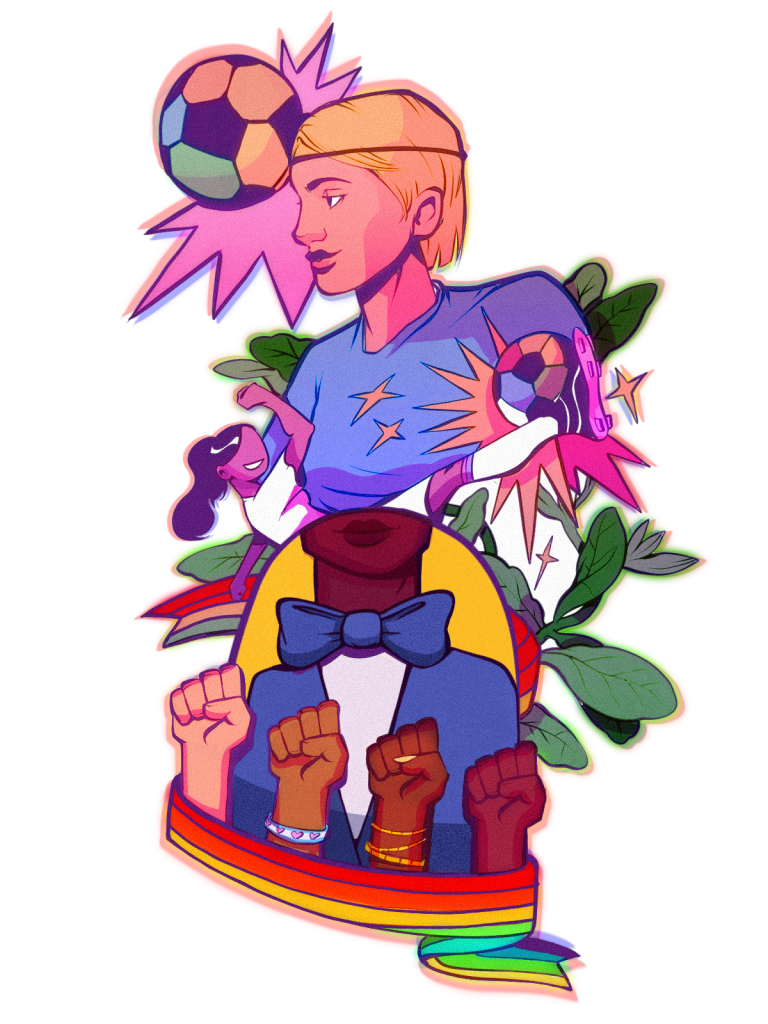


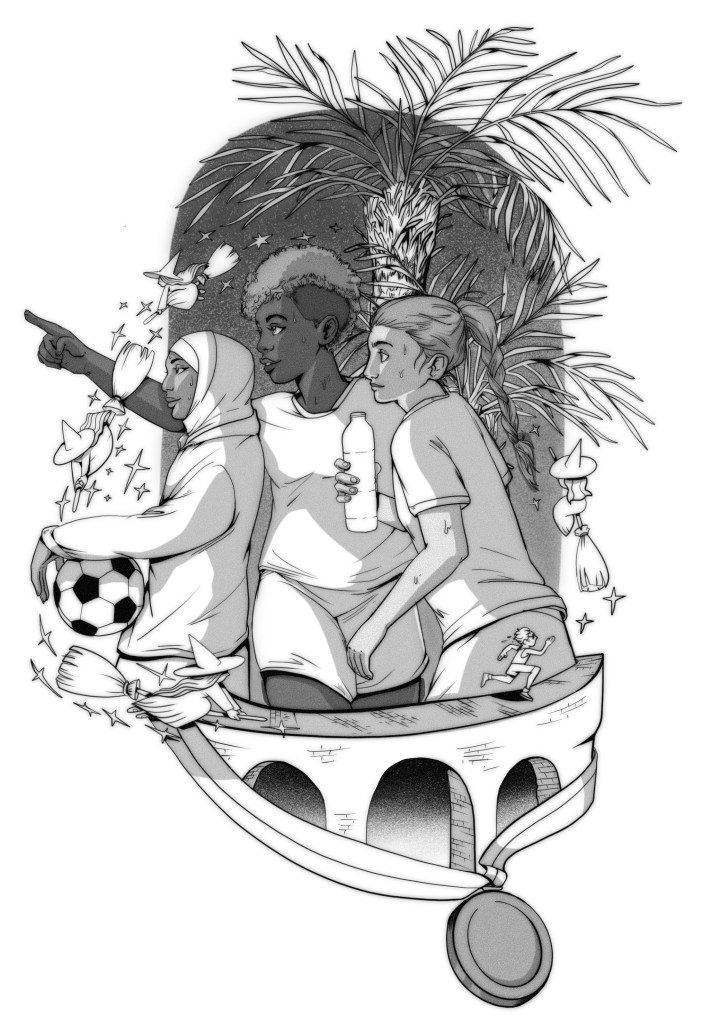
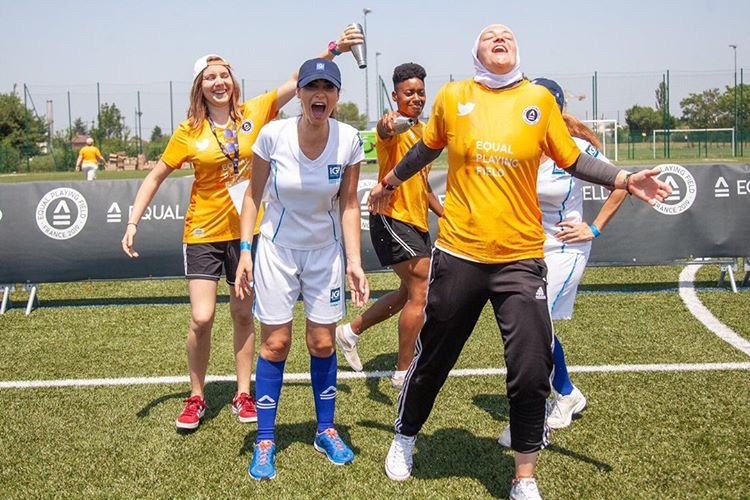

 HERE FOR THE LONG BALL