On this episode, was hanging out at the Festival of Football in Lyon, France when I met the amazing Supriya Kumari and Abhia Haider. Kumari is from India and Haider is from Pakistan, two countries that historically have not had the best political relations, and yet there they were laughing together like sisters. I wanted to hear their story, not just because their relationship intrigued me, but because I knew both of them had started playing soccer in cultures that highly discouraged girls from participating in sport. More on Kumari: at the time of our recording, she worked for Yuwa, a nonprofit that operates in rural Jharkhand, India, where girls are highly at risk of child marriage abuse and human trafficking. The organization teaches soccer to youth in other to educate young women and to help them achieve their goals. And as for Haider: she played for Pakistan’s national team and is now a lawyer. This convo was a lot of fun y’all. I hope you enjoy.
To get updated on new content, sign up for the email list or follow me on Instagram, Twitter, or Facebook. And consider making a donation! the money goes to support all of the artists and creatives making the magic happen.We so appreciate you <3.
On a balmy Saturday evening in Lyon, France parties of people gathered before the Hotel of God. It wasn’t a holy ensemble per se, unless you consider romance a religion: The pious lounged beside the Rhône River to drink up the rosy sun at dusk.
As darkness descended, the water began to glow. Liquid gold reflected the hotel’s ethereal lights. Couples sipped wine and sucked lips as my friend, Emma, watched me toss a sandwich at a flock of swans. Skateboarders ka-kunked-ka-kunked on the cobbled paths while a guitarist crooned somewhere in the crowd.
But the only show that got any applause — and some bewildered laughs — was a man who had no intention of being the entertainment.
He wore the classic road runner’s kit: white tank; blue shorts (too short) that billowed a bit; worn shoes and tube socks; the sweat that streams when it’s hot. He sprinted to one end of the quay, then back, faster than anyone had expected.The guy must’ve been in his 70s but he showed nothing of age slowing him down. What was time but the rhythm of the clapping? The milliseconds it took for cheers to reach his ears? The minute it took for him to complete a shuttle?
There and back. There and back. The crowd ooo-ed and aah-ed — shot vids to Snapchat.
As I watched his lanky frame gallop on stone, I thought that his passion for running was an animal worth studying. My team would need his tenacity in this heatwave. My team would need all of his enthusiasm to finish pulling this off. And his joy.
I came to Lyon as one of many volunteers of a nonprofit called Equal Playing Field (EPF) to complete one daring mission: To play the largest 5 v. 5 soccer match in the history of soccer. To earn a Guiness World Record in the name of gender equality. Codename “Festival of Football” would need over 800 incredible womxn (and their allies) from all over the world to sub in and out of the match and about three days to complete. That meant over 60 hours nonstop. This wasn’t a show.
But damn were we having a ball.
Leaps in the Dark
Two days prior, I had arrived to this city the way Winona Ryder enters most scenes in Stranger Things: sweaty, with bug eyes darting for help, and a quiet defiance that said “Eff you” to anyone who dismissed her as some kind of martian.
Fine.
She didn’t need you.
She would make it on her own if she had to.
She who couldn’t use Google Maps because, again, Non, monsieur. Je n’ai pas de ‘Wee-Fee’ or data. She who was trying to follow the rivers on a street map that didn’t account for the construction that would disorient her.
I was lost, searching for the spot I would meet up with my friend Susie who had the keys to the AirBnB.
I wandered around in 104 degree heat like a swamp thing, crop top pasted to my stomach and jeans soaked to high tide. After hours of dragging my suitcase through small alleys, school courtyards, and no-AC train stations that smelled like l’eau de socks, I did the smart thing my pride wouldn’t let me do earlier: Hail a cab.
I asked the driver to take me to Quai Saint Vincent where Susie was watching England play Norway at her buddy Amanda’s place. When Susie greeted me at the door, her cool blue eyes washed over me like holy water at a baptism. I swear I could hear angels singing as they welcomed me to delicious, orgasmic, bone-chilling air conditioning, and a fried chicken sandwich.
Susie and Amanda pointed towards the takeout and wine sitting on the kitchen counter.
“Help yourself,” they said.
Hallelujah.
I changed into dry clothes, sat on the couch in front of the TV and chowed down. In between bites, we all talked about how excited we were to play with EPF that weekend — how everything was supposed to start today but that it was too dangerous to play in the heat. We talked soccer and agreed that Norway might actually be tough for England to beat.
It was so nice to hang out with Susie again. We had met at a charity soccer tournament in NYC a few years ago, and the two of us vibed on the fact that we both played in the Ivy League. She played for Harvard in the early 90’s before America even paid attention to women’s soccer — right before the USWNT won their first Olympic gold in ‘96. Susie was a part of the generation that built the foundation for players like me. She is one of the many unsung heroines who were born around the time Title IX had passed in 1972.
Still, I ribbed her for being a stinkin’ Crimson, and we kept in touch on Twitter ever since.
While I didn’t have much of a chance to get to know Susie in person, I had the honor of reading an early manuscript of what is now her award-winning memoir Raised a Warrior. In her intimate, coming-of-age tale, she recounts what it was like as an athlete to understand America’s narrow sense of “womanhood” and to wake up to the world’s glass ceilings and sticky floors.
When Susie was in high school, her team didn’t have a gym or a field. So for practice, they drove out to the Rose Bowl complex to train on a grass lot that was used as a parking area for UCLA football games. They had to run around the tire marks that often trenched the pitch.
Days before their first game, her teammates realized they didn’t have a uniform, so they had to dig up a box of jerseys long forgotten somewhere in storage.
“We started to pull them out of the box one by one,” she wrote. “There were shirts with different collars, some with long sleeves, some with short sleeves, two shades of brown, at least two different fabrics, some brown cotton, some brown polyester. There were three No.7 shirts, and not a single pair of shorts. The numbers were easy to fix – we used white athletic tape to change one No.7 to a 17 and another to 117 – but the shorts were a problem: we just didn’t find any. I called every kit supplier in the phone book that afternoon to ask about brown shorts, but no one had any.”
Instead, her teammates pitched in to buy neon pink beach volleyball shorts to wear for the entire season. Just thinking about serious soccer players running around in booty shorts makes me giggle and pick an empathetic wedgie.
Sometime during the second half of England v. Norway, another one of my sheroes arrived: In walked Moya Dodd, former Australian national team player and a previous member of the FIFA Council. Even amongst the corrupt mess that was FIFA-gate, and despite not having any voting rights, Moya was one of the few female voices to push for more investment in women’s football amongst other gender reforms. And now here she was, standing before me with her partner, daughter, and a platter of cheese.
We shook hands and I told her how honored I felt to finally link up face-to-face. Earlier that year, we had talked on the phone as I helped to edit one of her personal essays. I just love some of the stories she shared about the beginnings of women’s international soccer.
As a teenager, she had to take on various part-time jobs to afford soccer expenses. She picked oranges in the summer, shelved books at the library, sold ads in the newspaper. And if she already wasn’t a badass, she rode a motorbike around town because it was cheap.
When she made the South Australian state team, her squad often stayed in low-budget motels where they squeezed three to four players per room.
“We’d have to wash our own gear at the motel laundromats, or in hand basins in our rooms, and then find places for it to dry,” she wrote. “Socks and underwear were everywhere. Once […] we got creative and tied some clothes to a ceiling fan. We figured they’d dry faster spinning through the air at high speed, but they just flew off. When our coach walked in, he couldn’t work out what was going on. The room was filled with laughter. The floor was covered in undies.”
It always amazes me how much womxn are willing to sniff out and make the resources that aren’t given to us. This pursuit — albeit frustrating and painfully unjust at times — can bond us in the most absurd, daring, and adventurous ways. I’ve seen it turn many into compassionate leaders, brilliant storytellers, and …
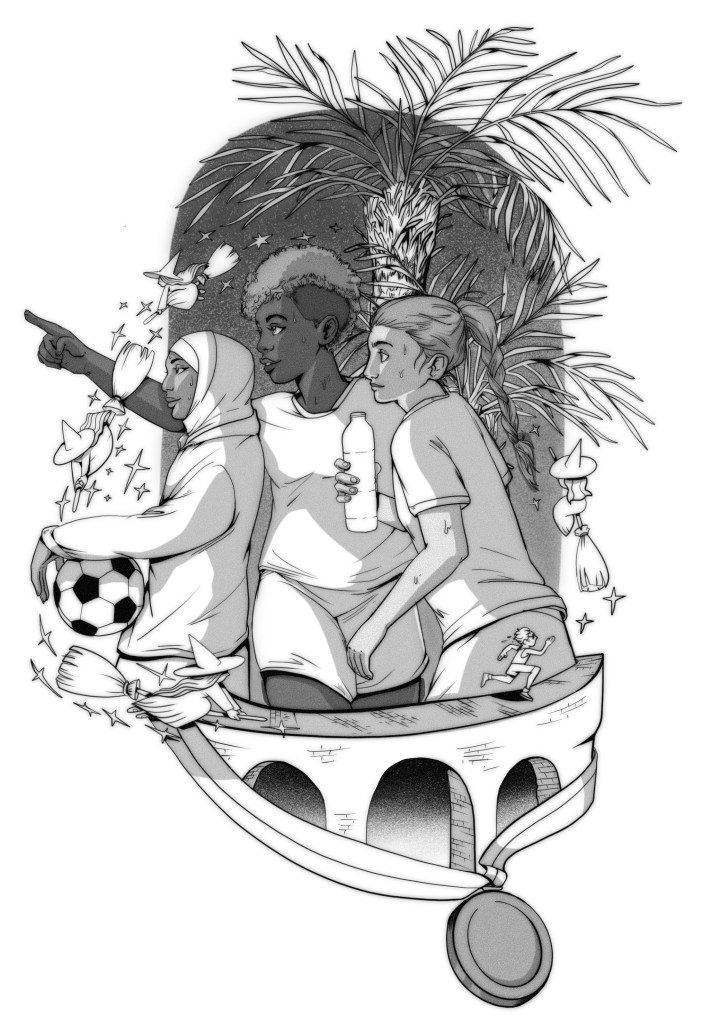
Witches.
Witches we were, making up spells without always having the book. Conjuring something from almost nothing: Our dreams. We cherished them like enchanted beans despite the unyielding earth, and for some of us, the scathing witch hunts. And yet many of us took our chances not knowing what we’d reap. Or when. We took the risks of feeling unheard, unseen, hoping that people would eventually see our magic.
Now look at what we’ve created in the dark — what bloomed while the world slept.
My friends and I were among the 7.6 million UK viewers who watched England trample Norway 3 – 0 that night. A record high viewership for women’s football in Great Britain. Evidently, part of the world had awakened.
After the game ended, Susie and I left to go to her AirBnB on Rue de Plat. She called an Uber, and we waited on the sidewalk. It was a pleasant, breezy night after what was a suffocating day. The street glowed bronze under gentle lamps. You couldn’t see much beyond the quay besides the lit up apartments and a golden tower on a hill that looked something like the Eiffel Towel.
We heard a splash somewhere in the shadows. Then chatter. Laughter. There was probably a bunch of kids hanging out on the nearby footbridge each taking their turn to dive into the marble waters of La Saône. I shuddered thinking about all the what if’s, the unknowns: The river being too cold, too dirty, too shallow, too boat-y. I wouldn’t dare.
I asked Susie if she’d ever do it. You know, jump into the river like that.
“When I was younger, I would do stuff like that. But now I’m smarter … or maybe I’m just scared.”
I laughed because I know how courageous she’s been, and how that courage never really leaves a person. Perhaps now it shows up in other places: Being a mom, writing what’s on her heart, directing a women’s soccer film. Spending all the time and money to come to France and be part of this team despite the deadlines hanging over her head. She might be scared.
But Sooze takes the leap when it’s worth it.
Soccer Camp for Fxminists
For a moment, I watched the clear water waltz around my fingers. Let the cold kiss my skin.
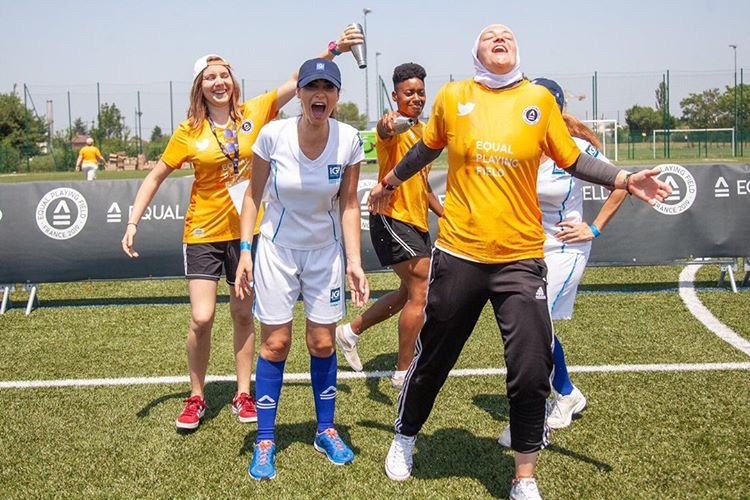
That afternoon, I was standing under a white tent among turf fields which baked in a haze that bent the rays of the sun. I dipped my hand into a large, clean garbage bin filled with what the players were supposed to drink. I filled my watering can — a little beach toy — up to it’s neon orange brim then filled the empty water bottles on the table beside me. I walked over to the pitch to where 10 athletes in red and blue jerseys jogged about with a soccer ball, smiling as they stopped to wipe their brows, occasionally speeding up to shoot. It was too risky to play all out. We were only 16 hours into our world-record breaking match and we couldn’t have anyone pass out from heat stroke or dehydration.
“Water! Water! Who needs water?” I yelled with bottles in my hands.
Two players, a mother and her four-year-old son, stopped their play to come get a sip. Man, that kid could dangle, I thought.
Delivering H2O was one of my main jobs at the Festival of Football. There weren’t any water fountains around, so the crew had to get creative. I was surprised that such a beautiful facility with multiple fields, a clubhouse, classrooms, a kitchen, and a stadium sound system, didn’t have easy access to water. Maybe I was missing something…
Because otherwise, Equal Playing Field (EPF) couldn’t have picked a better location for this event. We were playing at the Groupama OL Training Center, the home of one of the most elite women’s soccer clubs in the world: Olympique Lyonnais. Six Champions League titles. Fourteen back-to-back domestic league titles.This team has developed international stars like Wendie Renard (France), Alex Morgan (USA), Lucy Bronze (England), and Shinobu Ohno (Japan).
OL, who’s female squad was founded in 2004, has been a prime example of a men’s club making women’s soccer a priority. From academy to pro, all of their athletes male and female share the same training facilities and medical staff. Coaches and players from men’s and women’s teams often swap ideas and support. The female pros are paid a decent salary, even though the pay still pales against what Messi banks a year. And the women only play at the large Groupama Stadium for major games (like Champions League bouts). But generally, the tone of Lyon is this: both genders are treated equally no matter what level of the club you are in.
Across the pitch, I could see Sandrine Dusang, an OL alum and formal French national team player, chuckling with some of her friends on the sidelines. I imagined she was overjoyed that the EPF gang was back together, again doing the unthinkable for a cause that meant the world to her.
When I met Sandrine earlier, I noticed she was carrying the cleats she had on when she hiked up Mt. Kilimanjaro to play the highest altitude game of football (EPF’s first Guiness World Record). I knew this because she had it inked somewhere on the leather. She laced them up as she teased one of her buds. I thought maybe she was one of the bigger goofballs of the EPF sisterhood.
Or was it Yasmeen Shabsough from Jordan? The woman who dared to play soccer in a climate where girls were highly discouraged.
“HEY!”
Suddenly, a cold stream of water ran down my back. I turned around and watched Yasmeen cackle as she ran away looking for her next target. That jerk. A sly smile crept across my face when I suddenly realized: This was a soccer camp for a bunch of instigators.
Many of whom clearly enjoyed Sean Paul. The speakers had blared back-to-back Dutty Rock all day.
Getting Yasmeen back. Photo credit: unknown
“Yo, who’s been bumping Sean-da-Paul this whole time?” I asked.
“Oh that’s my boy,” said another volunteer. “It’s a playlist on his phone.”
“I kinda don’t hate it.” I bopped and swayed with other athletes who were watching FIFA refs train on another field.
In the classrooms I learned other dances.There, various non-profits had gathered to teach and exchange ideas on how to teach young girls life skills through football, how to overcome sexism in the workplace, how to boost team morale. A Black woman from South Africa had the best cheer of anyone. She had everyone on their feet shaking their booties, parroting chants at her command. Afterwards, a group of young Indian women from Yuwa — an organization that develops soccer programs for young girls who are often susceptible to child marriage — motioned me to hang out with them outside. They taught me a little boogie that was trending on TikTok.
While we often didn’t speak the same language, I was amazed at the immediate closeness I felt from the womxn I had met. This isn’t always a guarantee. Not in a world where we are often pitted against one another. I guessed it was because we had this rare melange of mediums at our disposal: music, dance, and sport. Rich mediums that enlivened all of the senses, that cut through small talk and served up a piece of our hearts.
Actually, there was a moment where I was challenged to go even deeper with a sister. In one of the workshops, I was asked to stare into the eyes of the person sitting next to me: Mabel Velarde, an Ecuadorian national team player who participated in the 2015 World Cup. Facing each other, we sat in silence for 40 seconds. As I looked into her golden brown eyes, I noticed how the room, her face, my discomfort faded away. My mind emptied itself of all narrative, all assumptions, and for a time I couldn’t see anything separating her and I — just the innocence of those rich, nutty irises. This was a lesson in intimacy a touch beyond my human perception. And therein lay the truth.
We are as much different as we are the same.
And truly seeing one another in that polarity can feel like the way your pupils bounce back and forth when you’re up and close with someone. When you’re trying to capture the whole of them. This is the dance that requires the utmost presence and the utmost respect.
Nothing less.
On one of the fields an 11 on 11 match had just begun. Someone bet that we could also break another record for playing a game with the most nations. When a woman on the pitch undressed to change her jersey, a male athlete whistled at her. A catcall. The ref gave him a red and both teams boo-ed him off the pitch. I laughed because I think this guy forgot where he was and why we were doing this. We weren’t going to put up with any objectifying bullshit.
When the moon rose, the turf cooled. At 11 PM I finally hopped into the 5 on 5. The stadium lighting was electrifying and I let my feet speak for me. Let them sprint, dribble, dodge, and jive when I scored. I didn’t play for very long. Maybe 20 minutes. It had been a long day.
When I subbed out, one of the volunteers handed me a silver medal. “WE HAVE MADE HISTORY” was etched in the center, as if it had already happened. And it would. And there would be a big celebration with sweaty hugs, high fives, wine, cheers, and pictures. But not until the next day, and I would only be there in spirit.
My job here was done, and it was time to wait for a shuttle to get back into the city. As I lay down on one of the inflatable bean bags next to the field — the ones meant for the volunteers to nap on as they worked through the night — I closed my eyes. I thought about my elementary school self and how often I asked the librarian for “The Guinness Book of Real World Records”. (I always butchered the title somehow.) Back then, I was so in awe about all of the incredible feats humans could accomplish on their own.
That kid would be ecstatic to know that she would be in that book one day, and proud that she didn’t do it alone. Lil’ Adele always wanted to feel a part of a team. A family of friends.
Bet she’d never imagined being a part of a squad so immense.
To get updated on new content, sign up for the email list or follow me on Instagram, Twitter, or Facebook. And consider making a donation! the money goes to support all of the artists and creatives making the magic happen. We so appreciate you <3.
For the Here for the Long Ball (#H4TLB) Audio Edition, I spoke with the amazing Erin Blankenship who is a conflict and security specialist as well as one of the founders of Equal Playing Field, a non-profit that uses soccer as a tool to end gender inequality in marginalized communities across the globe. What Erin and EPF accomplish every year is just amazing. From playing soccer on Mt. Kilimanjaro to setting up a match at the Dead Sea. They break world records to bring attention to their cause and I wanted to better understand how and why they make this magic happen. So before I left for France in 2019 to help them break yet ANOTHER two records, I got a chance to speak with Erin about growing up playing sports in Saudi Arabia and how that ignited her passion to foster more gender equality through sport.
To get updated on new content, sign up for the email list or follow me on Instagram, Twitter, or Facebook. And consider making a donation! the money goes to support all of the artists and creatives making the magic happen. We so appreciate you <3.
 HERE FOR THE LONG BALL