“Let’s face it: Money gives men power to run the show. It gives men the power to define our values, and define what’s sexy and feminine. And that’s bullshit. At the end of the day, it’s not about equal rights. It’s about how we think. We have to change the perception of how we view ourselves.” — Beyoncé, Life Is But a Dream
Under the lights of Groupama Stadium in 2019, a patchwork of American and British fans spread across the seats like a worn quilt. Ruffled and warm, it billowed and fell with bones swayed by the waves of our emotions. (Look closely to see the dark sweat in our seams).
Sixteen euro and I had one of the best seats in the house thanks to Natalie, a woman I had met a few days prior at the Festival of Football. Lucky for me, she had an extra ticket to the semifinal last minute. We sat right above the U.S. goal, drinks in hand, doing what most peanut galleries do: analyze the match like we knew better — woulda chose better — than some of the best talent in the world.
Still, we tossed our opinions back and forth as if playing catch: feeling our words leave our tongues and land in our ears; letting our minds play around with perspective, variations of our truths. This was how two strangers began to know each other through echoes. Like,
“Man, Rose Lavelle is tearing it up in the midfield. I love watching someone so small hold her own in traffic like that.”
“Right? She’s killing it. Even my dad’s a superfan.”
[Shared values: defying stereotypes, beating the odds.]
And,
“Crystal Dunn has done a great job shifting from forward to defense in such a short time.”
“Yeah, I doubted Coach Ellis at first, but watching Dunn skillfully attack from the back really adds another layer to the U.S.’s offense.”
[Shared values: versatility, dynamism]
We were building, laying…
[bricks] [of]
[The] [bridges]
…connecting. Finding common ground.
We both agreed that this wasn’t the best tournament that we’ve seen from Alex Morgan. Besides the five goals the U.S. captain had scored in the team’s 13-0 blowout against Thailand (a World Cup debutant), she hadn’t found the back of the net since. This was unlike her. Or at least unlike the reputation that she had built.
The forward had an incredible résumé. For example, during the 2012 international season, she scored 28 goals and notched 21 assists, joining Mia Hamm as the only other American woman to collect over 20 goals and assists in one calendar year.
“But it seems like this time around, she’s been better at drawing fouls than scoring goals,” said Natalie, and the moment that sentence left her lips, a frustrated Morgan flopped onto the field. The ref blew the whistle, and I reclined in my seat, amazed at Natalie’s observation. “Oh my God, I think you’re right.”
Is Alex Morgan actually as good as everybody says she is? I thought.
[“Good” meaning…?]
This was a question I had discussed many times with my family and some of my soccer friends. I don’t remember these conversations containing a lot of deep soccer analysis or stats. (For a better take on that, you may want to read Jeff Kassouf on how Morgan’s role has changed over the years.) Instead, I found that two themes cemented the tone of our talks:
“Alex Morgan is overrated.”
[Rated over what?]
And, “She’s too commercial.”
[“Commercial” meaning…?]
Sometimes when we sports fans talk about liking or disliking a certain athlete, I don’t think we get to the core of what we actually mean. We don’t really talk about why we feel a certain way about a player much beyond whether or not the player is putting points on the board. Or maybe it’s another number. Statistic. Boiling the human experience down to math. Arithmetic. Sometimes, when we talk sports, we don’t want to dig deeper or aren’t yet awake to what’s behind our commentary.
But recently when Morgan — a celebrated feminist and heroine to many — has come up in conversations with my buds, I’ve felt that there was something festering underneath our words: a curious umbra beneath a long and tunneling overpass that first had me wondering, “Why exactly do my friends love to hate on Alex Morgan?”
And yet to ask this was to deny the pettiness that crawled within me and masqueraded itself as self-righteousness. For me, there’s a lot of shame and fear in integrating this lonely creature, in calling her back home.
To beckon her forth, the question wasn’t, “Why does my circle love to hate?”
It was: “Why do I?”
This really wasn’t about “Alex Morgan” the person or her talent.
This was about a shadow I’ve cast in her place. A cloud that needed to be traced so I could understand the nature of my perception: to pick apart how it’s influenced, how it affects my judgments of and interactions with others, as well as how I see myself.
I once worked with a self-love coach — the wise and intuitive Melissa Simonson — who taught me to get curious when I am continuously triggered by certain types of people. (Triggered could mean a bunch of things: annoyed, bothered, judgmental, spiteful, etc.) When I notice a pattern it’s time to ask:
“What needs or values are being mirrored to me through my judgement of this person?” (Or this shadow, rather.) And then, “Is there something that this person is expressing that I decided I’m not allowed to be?”
Well, Coach, I wasn’t always a part of the Petty Party. At least not towards the Alex Morgans of the world.
I’ll never forget seeing the “Baby Horse” make her World Cup debut in 2011. Morgan, then the youngest member on the team at 22-years-old, lit up the pitch every time she entered as a sub. She had incredible speed on and off the ball — something I really admired as a track athlete. Her long brown mane flowed behind her as her tall legs galloped past defenders. It was beautiful to watch. She was beautiful.
Morgan had blue eyes clear enough to swim in. America plunged into the deep end and flooded her Facebook page with marriage proposals. Morgan was also smart, engaging, hard-working, and tenacious — characteristics honored by most American fans. The media pegged her as the next face of U.S. women’s soccer. She became a new role model to inspire young girls everywhere. I was awed by her. Just thinking about Morgan’s breakaway goal in the final gave me chills.
That fall, I returned to college still brimming with the excitement of the tournament. Even though the U.S. lost the championship, that game had everyone on the edge of their seat. Over 13 million viewers tuned in, which at the time was the sixth-largest TV audience of a soccer game in U.S. history. Women’s soccer was cool now, so I thought I could finally connect with my guy friends on the track team about it.
“Did y’all watch the U.S women play Japan? It was incredible.”
“Yeah, and that Alex chick is so hot,” one of them said, as they pivoted to discussing her looks and how attractive the other women on the team were.
This wasn’t a shock to me since media outlets like Bleacher Report and others had a habit of ranking female athletes according to their hotness: a poor effort in expanding women’s sports coverage à la objectification. But it was still disappointing to me to think that part of the uptick in viewership included a bunch of men who just wanted to gawk instead of fully appreciate what these women had achieved.
Eight years and three Alex Morgan Sports Illustrated swimsuit covers later, a part of me had solidified her as this untouchable symbol of the American feminine ideal — one that is raced, gendered, and heteronormalized. It seemed like it didn’t matter if she was playing well or poorly. She still was going to be “it.”
Ironically, this, too, was a form of objectification on my part — a flattening of a person used to paint some maladaptive narrative of feeling rejected. Meaning: Those times that I grumbled about the countless girls wearing “Morgan” on their jerseys at USWNT games were actually expressions of the 12-year-old in me who wanted to be like her, too…or rather, someone like her: Mia Hamm. For my younger self, Morgan didn’t exist yet. Hamm, though, was someone elementary school Adele would’ve loved to embody; she just didn’t feel like she really could.
Elementary school Adele would tell you about those soccer games when all of her teammates thought it would be cute to pull their hair up into super-high pigtails. How their straight, thin hair went up so easily. How the parents raved. Her twists resisted, whining at the root as they were tugged into ties. Or did she have those braid extensions that summer? The ones that looked beautiful for a month or two then occasionally fell out when they were tired? The ones she’d rushed to hide in her pocket before her white classmates saw?
By her freshman year of college, she’d permanently straightened her hair and made the varsity soccer team, “the prettiest team on campus,” the upperclassmen half-joked. That fall she made out with the star kicker on the football team and showered in the applause from her teammates. She felt like she was finally getting it. That she’d matured into someone wanted. Appreciated. But there was something hierarchical about this new sense of pride. Something that put a piece of herself in the backseat.
One day, she was sitting on the bench when she overheard one of the assistant coaches talking about how he went about recruiting: If two players in the same position had equal skill, he was obviously going to pick the more attractive one. Another joke, she hoped. Full joke.
True or not, after that moment, she started to see her team differently. Her sport, too. As much as soccer taught her that your skills and heart spoke louder than appearances, she was still trying to fit into a world shaped and whittled by white men and their preferences. This effort was heavy. In some ways, she was breaking under it. Her then-straight hair had many split ends where she wore her high pony.
So, Coach,
What need was being mirrored through my judgments of Alex?
My need to understand how to embody my beauty without supremacy telling me how to.
A need to feel seen in my own unfolding.
This void, this hole was not my creation but something I’ve tripped and fallen into countless times. I’m still mapping it out — still trying to fill it in — but I want to believe I know the edges pretty well.
This journey began when I chopped off my straight hair and shed what wasn’t mine…when I had realized I had been seeing myself through the wrong eyes.
I was seeing through the lens of TV screens and magazine spreads: “America’s Next Top Model,” Barbie commercials, CosmoGirl — Clarissa Explains It All, even. All of these reflected the beauty standards of the 90s and early 2000s. You could tell based on who they put at the center, who they made their stars. But these standards aren’t unique to Hollywood. These standards leak into everything. Even sports.
You know what’s funny? Soccer has done so much to show me how to be present with my body. It’s taught me to relish in the clean strike of a ball off my foot. And to this day, I squirm with delight when I’m sore. That soreness means growth. Strength. There is ownership here. A sense of capability and power.
However, there’s an aspect of soccer culture that has left me feeling disembodied. I think it’s rooted in what scholar Jaime Schultz calls the “beauty-myth recoil” of the 1980s.
After Title IX sparked “the sports revolution of the era” in 1972, many feminists celebrated the progress towards physical equality and autonomy. But this progression — which disproportionately benefited white women of higher economic status — was met by a beguiling resistance in the media garnished with aesthetic rhetoric. This occurred during the 1980s when the first “strong is the new sexy” movement began, and “strong” here largely meant lean, tight, and light-skinned. Sports journalists (most of whom were men) wrote about how women who participated in athletics were better in bed. From this perspective, it seems like the only way some cis-straight men could accept this movement was by framing it in a way that benefitted them — all the while belittling the effort and talent put forth by these up-and-coming female athletes.
Taking this stand seemed to be a profitable stance, too. Focusing on female-athlete sex appeal was seen as a way to draw in formerly uninterested male sports fans and nonsports fans alike. Like that time in 2004 when former FIFA president Sepp Blatter suggested that “the women play in more feminine clothes like they do in volleyball.” Tighter shorts would supposedly attract more audiences and bring in more money. This suggestion to wear something “more feminine” was not only sexist, it was reflective of the homophobia and transphobia that still lurks within women’s sports culture.
Sports are still largely oriented “for the boys,” for hetero-male viewers and their supposed preferences.
But to place all the blame on the male gaze is false and ignores the role of women in sports and fitness beauty politics. During the 1980s aerobics boom and the reign of Jane Fonda, achieving the ideal body type — whether through sports or Jazzercise — was a sign of personal mastery, discipline, and legance to womanhood. Even now, it’s easy to praise and shame each other, ourselves, against these standards, Hope Solo’s abs, and Carli Lloyd’s legs.
I’m now thinking about that iconic image of Brandi Chastain from the 1999 World Cup where she’s on her knees roaring sweet victory in her sports bra. That picture challenged our crusty old notions of which expressions, which bodies were considered “ladylike.”
This image also represented the moment that women’s soccer became the stage for the celebrated versions of femininity in American athletics.
Not only were Hamm, Chastain and the others phenomenal athletes, many of them checked the boxes of a feminine ideal that leant itself to hetero-sex appeal and idolatry. I say this not to blame these women but to call attention to the water we are all swimming in.
The water makes me wonder about the the nonbinary and trans athletes, who still play (if they are allowed to) in cis-oppressive and heteronormative environments. I think about my sister who was told she had to lose weight before a college coach would consider recruiting her…my former teammates with eating disorders.
I get really curious about the way the women’s national soccer team gained such notoriety when the U.S. women’s basketball team (which is largely Black and queer) doesn’t get as much hype despite their back-to-back gold medals and the long-standing presence of the WNBA. (None of them, by the way, are included on Nielsen’s list of 50 most marketable athletes). I think about the U.S. women’s national hockey team: bodies all suited up in pads, and helmets. Hidden. Masked. “Needing” to be proven feminine, unalien.
“We’re normal women,” defender Monique Lamoureux-Morando told ESPN for their 2017 Body Issue. “We like to be feminine. We love to get dressed up and be pretty. But we love to train and be strong and be aggressive. There’s this misconception that, if we play ice hockey, we’re a certain way off the ice. We’re normal.”
What is this “normal”?
America, on what and on whom do you place your value? Because as Mikki Kendall writes in her book Hood Feminism, “Pretty comes with privileges, and when one’s health, wealth, and opportunity for success in this country are impacted by looks…who gets to define pretty matters.”
On my flight to Lyon, I read a Time magazine profile on Alex Morgan and her advocacy of equal pay, and within it Hamm said something that made my heart sink. “When I was playing 75 percent of my money came from endorsements, 25 percent came from playing,” said Hamm. “I would love for that to be flipped.”
This means that the split hasn’t really changed. This means that female athletes still have to play into the market’s hands — hands that still hold onto beauty hierarchies and trends. Beyond the field, female athletes have to put in the extra work to show that they are normal enough, pretty enough, liked enough, trendy enough to make a decent dollar. Those who don’t may not enjoy all the corporate sponsorships and have to make do with their league’s salary and other forms of support.
In the past couple of years, I’ve watched America celebrate the retirement of Abby Wambach. I’ve watched (at least part) of this country rally behind Megan Rapinoe. They are two out members of the LGBTQ community who paved the way for many to be who they are in sport. It is clear to me that we are increasingly leaning toward celebrating diversity.
However, there is so much more to be done. If we can’t chuck them out entirely, we need to create more inclusive beauty aesthetics not just to further the conversation on equity but to also increase access and overall well-being for folx of all shapes, sizes and forever-changing bodies. Otherwise, we’re ignoring what’s in the mirror.
While I parcel out how to dismantle the pageantry of women’s sports, I recognize that many of us have tried to solve this issue before.
One way many feminist sports fans have done so is to focus on an athlete’s talent over her looks; take beauty politics out of the conversation; minimize talk about a woman’s sensuality, sexuality, diet, and fashion; speak about her strength, skill, and stats…put this all together and you begin to treat female athletes like their male counterparts. I kinda like this.
But why have I been feeling like something is lost in this process?
When I was a sports writer at (the now-defunct) Excelle Sports my coworkers and I would talk about how much we loved ESPN Magazine’s “The Body Issue”and how it was way better than Sports Illustrated’s annual swimsuit spread (like, ick).
To us, the Body Issue handled nudity with a delicate awe of human form and a charming dash of humor and joy. On one page you’re (somehow) simultaneously looking up and straight at Breanna Stewart landing a dunk in the buff. The next page, you’re smiling with a laughing Tori Bowie, just beaming light in her midnight skin. In The Body Issue, you find male and female athletes of all ages, side-by-side, participating in a wide range of sports.
Flipping through the Body Issue always felt liberating to me. It was like their embodied pride became mine.
On the other hand, I don’t think I’ve ever held SI’s Swimsuit Issue. To me it represented the epitome of pandering to the white male gaze. It didn’t matter how many strong female athletes appeared within its pages (Alex Morgan, Sloane Stephens, Aly Raisman, Simone Biles, Ronda Rousey, Danica Patrick, Serena Williams, Skylar Diggins, Crystal Dunn, Megan Rapinoe) or how “classy” they posed. It felt as if the act — looking at women lying half-naked in the sand with those eyes Nala gives Simba when they’re “feeling the love” — was robbing me of my Disney innocence. Like I too had become a sexual objectifier of women by looking.
There are good reasons backing this discomfort and disdain. Perhaps those feelings are best described by Canadian journalist and former member of the Trinidad and Tobego national soccer team, Geneva Abdul:
“Years have gone by in Sports Illustrated’s history without a female athlete appearing on its cover, but, every winter since 1964, there’s been a woman in a bikini,” she wrote in The Globe and Mail. “We’re quick to glamorize the female body, but when it comes to athleticism, women are nowhere to be found […] We don’t need to be naked to be powerful. We already are.”
Yes we are. And yes, it’s highly problematic that a publication centered on a male-dominated sport industry makes millions off of female bodies who still get paid less than male ones. Certainly there are many people drooling over these women without understanding what it means to honor them. Trash that.
I am curious, however, about the models themselves and how their choice, their agency is often left out of this conversation. We often look at these athletes as if they have stepped down from their feminist-role-model pedestal to impress guys. And really, who’s to say but the athlete themselves, some of whom feel like they need to justify and defend. Like Olympic swimmer Jenny Thomson in 1994:
“My stance in the picture was one of strength and power and girls rule! It’s nothing sexual…”
And if it was, Jenny?
You see, I’m stuck on this Nala energy that’s rarely seen of female athletes outside of men’s mags. This magnetic force — bedecked in bikini, muumuu, three-piece suit, what have you — that sucks you in like an undercurrent. This is power. The seat of creation. So much of it has been harnessed on the “wrong” platforms that we cannot clearly decipher whether a model’s intent or impact is “positive.” And should that be our job? To paraphrase Schultz, the false binary of “oppressive-liberating” can be unproductive in this conversation. It is and could be both.
Regardless, this has me thinking about how difficult and confusing it can be for women to learn to embrace their unique sexuality, their sensuality for themselves. Part of the reason for this is because as model Paloma Elsesser says, sexuality has often “been co-opted into a performance for somebody else.”
“But sexuality is so deeply our own,” she adds.
Somewhere along the development of my identity as an “empowered” female athlete, this side of me has been disconnected. Perhaps this also adds to why the Swimsuit Issue made me uncomfortable.
Who have I not allowed myself to be?
I’m longing for a space where female athletes can — if they so choose — express this side of themselves without the white male gaze being the dominating presence, without pageantry. Because Nala energy lives inside all of us to witness, enjoy, and hold sacred.
Which parts of myself do I push aside in trying to be treated like “the guys”? Maybe something. Maybe nothing. Individual, decide.
On June 18, 2019, all eyes were on Marta’s lips: purplish red like bruised flesh and hungry for more, they were both a symbol of seduction and war. Although the Brazilian legend wasn’t on the pitch to entice, save to hypnotize her opponents with her dancing feet. She was out for blood — an Italian feast — in the last group stage game. And. Did. Marta. Eat. In the second half, Marta scored a penalty that lifted her team into the sweet 16. It was her 17th World Cup goal, which put her on the list as the best striker of any gender that the tournament has ever seen.
And to believe I missed it!
I only caught this historic moment during the news recaps after one of the other games. I was watching it with a woman who played soccer in the 80s, and she asked the question that many viewers had on their mind:
“Why was Marta wearing lipstick?”
Back in my friend’s day, soccer was the one place where she didn’t need to think about appearances; that’s how she felt most comfortable. Why Marta wanted to wear makeup on the field, she didn’t understand, but okay, sure. Go for it.
Perhaps that comment was coming from a person who genuinely felt like makeup is not for her. But I’ve heard this kind of talk before: talk of sports not being a place for “girly” things or things that get pegged as “feminine” display. (I mean, “God forbid the girl who plays with her hair down.”) To some people these expressions were a sign of being distracted and therefore were distracting — of caring more about one’s looks than the game, and thus taking away from a sporting feminist agenda.
Distancing oneself from that which has been taken to mark us as “less than” is an understandable recoil. Also: trying to prove oneself — to “lean in” to structures that were never built with us in mind — is an often-needed effort at survival.
This has been entertaining and rewarding. I think about that infamous Gatorade commercial featuring Mia Hamm and Michael Jordan. In that ad, “Anything You Can Do” plays in the background as Mia and Michael duke it out in different sports. I also think about tennis’s “Battle of the Sexes”: Billie Jean King’s victory over Bobby Riggs and how thousands anticipated that event as if it was the next blockbuster film.
This has also been exhausting. This form of internalized token syndrome is energetically expensive, and sometimes we pay the price with the depths of ourselves.
I see Marta’s journey illustrating this struggle. Women’s soccer in Brazil was illegal until 1979, only seven years before her birth. Reason being: the leaders believed that femininity was not compatible with the sport. And yet, as a young girl, Marta played pickup in the rural streets of her hometown. “She had to be quicker, more nimble, and more imaginative than the boys, who would do anything to beat her,” writes Louisa Thomas in the New Yorker.
When the ban was lifted and the Brazilian began to develop women’s leagues, femininity took on a different significance.
“Where femininity was once a barrier, it soon became a requirement for women attempting to play in the sport professionally,” writes Nicole Froio in her piece “Don’t Take the Red Lipstick Off.”
For example, in 2001, the São Paulo Football Federation started a women’s championship where they held tryouts. The preferences of the coaches were clear. They favored blonde, light-skinned women, regardless of their talent, while short haircuts were banned. Even beyond that event, masculine-presenting players like Sissi were often criticized and discriminated against by members of the Brazilian Football Confederation (CBF). This was one of the reasons why Sissi, one of the world’s best forwards of the late 90s, left the game. For the gatekeepers of the game, aesthetic policing was one way to keep women athletes “in their place.”
“Enforced femininity exists to attract male viewers, to soften the blow of women practicing a ‘masculine sport,” says Froio. “It exists to add normativity to the sport, it exists to exclude masculine women like Sissi.”
This is why when Marta suited up against Italy, she said, “Today…I’m going to dare,” and put on that crimson lipstick. That day the world learned that she in fact frequently wears lipstick, just never before on the international stage. This integration of one of her many expressions on the field was a reclamation of the so-called “feminine” in Brazilian soccer. Those red lips were battle stripes, striking out the constructs women have been forced to squeeze into. Her liberated passion demanded that her version of “femininity” be recognized and respected — that “femininity” was not something that shames women who express from another space in the spectrum. Her lips were her own to speak her uniqueness, her heart.
For similar reasons, this is why I loved Shanice van de Sanden that summer with her leopard-print buzz cut and bold maquillage. To me her style obliterated the need to balance these gender constructs in the way society demands. Both Marta and van de Sanden remind me that turning towards individual authenticity creates fertile ground for others to play freely in their own power.
♩Anything you can do, I can do different.
We can thus cocreate balance this way. ♩
I’m curious now about what becomes possible when we stop seeing women by how “well” they stack up to men. That is a central aspect of the white male gaze. I wonder what would happen if we dropped that narrative and explored what it truly means to explore our differences and the potential within.
When we embrace our differences…
We may find that we’ve been trying to fit into the wrong shoes.
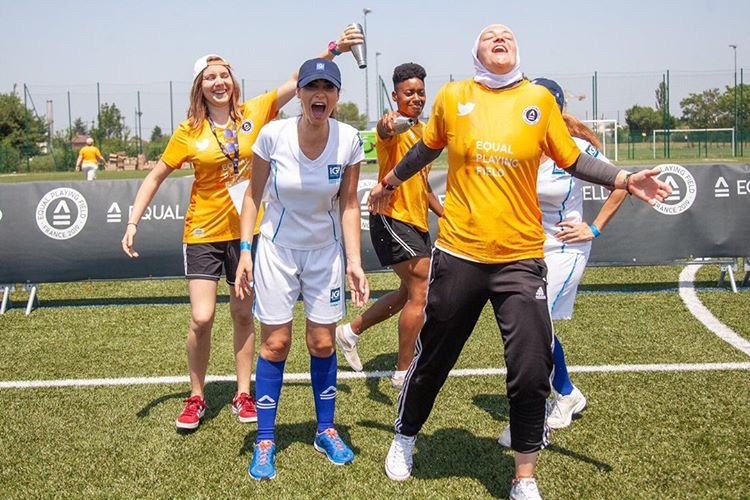
Two days before the World Cup final, I attended Equality Summit, where I had a conversation with Equal Playing Field’s cofounder Laura Youngson, who started a female-specific cleat company called Ida Sports. Youngson started it in 2018 when she was fed up with the lack of good-fitting women’s boots on the market and tired of wearing super-large kid’s cleats. From reading medical journals she discovered studies that revealed how oftentimes women’s feet are shaped differently than men’s; they’re not just smaller. And yet, most major sports companies make women’s cleats by cutting corners — by just shrinking men’s boots and offering them in pink. We all know playing in poorly fitting shoes is downright uncomfortable and in some cases can lead to injury. Female athletes are approximately five times more likely to tear their ACL than their male counterparts. Would we experience less if we had the right boots?
We may better understand (and accept) our bodies.
Ever since the day my mom gave me a little purse to hide my first “sanitary napkins,” part of me has always felt that menstruating was more than just a little uncool: it was uncomfortable, inconvenient, and just plain gross. But when I read that the USWNT was tracking Aunt Flo to win the World Cup, I started to think of my own Auntie differently.
At the Summit, I also met Georgie Bruinvels, PhD, a research scientist who created the period tracking app the players were using to document their energy levels, mood, and symptoms as their bodies flowed through each phase of their cycle. This information helped the coaching staff to know when to push an athlete, when to give them more recovery, and how to adjust their nutrition.
As someone who’s been coached to push through discomfort and sleep deprivation, as a player who’s often been told to “empty the tank” even when my body was calling for less intensity, this tracking thing was amazing to me. This discovery meant that I could release judgement when I felt like crying for no reason or wanted to lay in bed all day. I started to become even more curious about the messages my body was whispering to me. If I listened would the whispers louden to a clear and open conversation?
Most of our society (namely the hustle economy) operates according to the sun — a 24-hour cycle. Some experts claim that testosterone operates on this schedule as it diminishes as the day dwindles. For those of us who have a period, we tend to see hormones estrogen and progesterone as well as our energy levels cycle with the moon: roughly 24-38 days (although this varies). Whether or not you menstruate, there’s actually some studies that suggest that we might all have some degree of a lunar cycle and not know it. Regardless, I think if we look to the moon, there’s a good chance we might all finally begin to honor our feelings, and most of all, rest.
We may be able to loosen our grip on binary thinking.
Midway through the Summit, I sat in for a presentation called “Moving Female Physiology Mainstream.” It was presented by a woman named Celeste Geertsema, MD, a sports physician who worked for Aspetar, a FIFA-accredited “Medical Centre of Excellence.” She was talking about how “gender equality is not gender similarity,” and that every cell in our bodies has a sex, be it XY, XX, or any other combination. In other words, our sex chromosomes don’t just affect our hormones and other processes related to our gonads. They affect the biochemical behavior of each of the trillions of building blocks that make up our physical beings. They influence how our bodies react to stress, medication, our environments, and other stimuli.
Despite this knowledge, we have very little orthopedic research on female athletes, according to Dr. Geertsema. And so we don’t actually know how different women are from men when it comes to sports performance — or if we are really that different at all. I got from her that “different” doesn’t mean “less than”, but knowing the details of our differences could help experts optimize treatment and care for cis-women.
Of course, I knew it was more complicated than that.
As I was listening, I was thinking about the many people who exist outside the XY/XX paradigm — for example those who may be X, XXY, or who’s bodies just respond differently to hormones. I was thinking about South African gold medalist Castor Semenya, who was banned from competing as a woman since her body naturally produced “too much” testosterone for a female athlete. The International Association of Athletics Federation (IAAF) supposedly did this to preserve “fairness” in track and field (more specifically the 800-meter race, Semenya’s main event). But who could call this fair when trans athletes and intersex athletes are frequently denied access to sports?
I wanted to ask Dr. Geertsema about this since she was born in South Africa and understood the science of physiology and sex.
“Currently, we are separating sport based on sex, male and female,” she said. “That is wrong in the sense that it implies there are only two possibilities, and we know that this is not true.”
A person’s sex expresses itself differently according to many different factors: other genes, your hormonal expression, the protein receptors on your cells, cells swapped between mothers and their children. Some researchers suggest that many of us are “biological hybrids on a male-female continuum.” That some of us are mosaics of XY, XX cells and cells of other combinations. And so on some level the lines we are drawing are arbitrary. The lines we are using to discriminate and exclude are grey at best.
“Men vs. women” doesn’t truly exist. There’s something more holistically intricate.
As human embryos, we at one point understood this miraculous wholeness. Before we developed gonads, our bodies had the parts to form different types of sexual anatomy.
When I look at them, it seems like human embryos are the living shape of yinyang. These inseparable forces that are spinning with, against, and within one another — transforming each other — stirring the pot for infinite expressions and beautifully complex realities.
This embryonic perception can create the worlds that we want: sports cultures where all genders are welcome and celebrated; soccer teams where Black girls can play, feel beautiful, and know that they are enough. Societies where “feminine” expression isn’t co-opted by the white male gaze. Where women don’t have to win popularity contests to get decent pay.
I know these worlds are alive in the minds of those who imagine righteous futures. And maybe I’m being too optimistic but I believe these worlds will manifest because when I close my eyes to see it, it’s alive in my body. It’s this joyous liberation.
Envisioning has been a powerful tool used by our ancestors to create freedoms for those who had none. How we see the world and its potential shapes how we move about it. It can give any object, resource, painful and/or rewarding experience purpose. Movement.
Indian philosopher J. Krishnamurti once said, “Perception is expressing […] Seeing is doing, acting. There is no gap.”
Quantum physicists have shown how this is true through the “observer effect.” The double-slit experiment reveals that just the act of looking at atomic particles — the things that build our universe — changes the way they behave. Some scientists even go as far to say that our expectations and beliefs shape how these particles change. In his book The Orb Project, MIT physicist Seth Lloyd posits that the observer causes reality to reorganize according to what they believe is real or desirable. This would mean that we are all observing and shaping this collective experience, and deep, quantum change actually starts at the level of perception and belief. Paradigm shifts.
If this is too much of a jump, I believe many of us can start here — head out of space, feet on the ground: when the dominating perception puts white maleness at its center, this drives our culture, shapes our behaviors, and our relationships with ourselves and others on micro and macro levels.
If we were able to clean the lens of the white male gaze, how would we act in community? How would we value our bodies and bodies that have been “othered”?
In her book Emergent Strategy, adrienne maree brown describes that “we are in an imagination battle,” particularly when it comes to Black and Indigenous lives mattering in the U.S. The white gaze is the filter, the cage. “I often feel I am trapped inside someone else’s imagination and I must engage my own imagination in order to break free.”
We must continue to dream and continue to discover radical self-love, underneath the white haze. Let’s wipe it away and see all the beauty we’ve been missing.
To get updated on new content, sign up for the email list or follow me on Instagram, Twitter, or Facebook. And consider making a donation! the money goes to support all of the artists and creatives making the magic happen. We so appreciate you <3.



 HERE FOR THE LONG BALL