When we think of leaders…why don’t we think of ourselves? Maybe because our cultural understanding of leadership has omitted far too many of us for far too long…. The picture of leadership is not just a man at the head of the table. It’s also every woman who is allowing her own voice to guide her life and the lives of those she cares about. -Abby Wambach
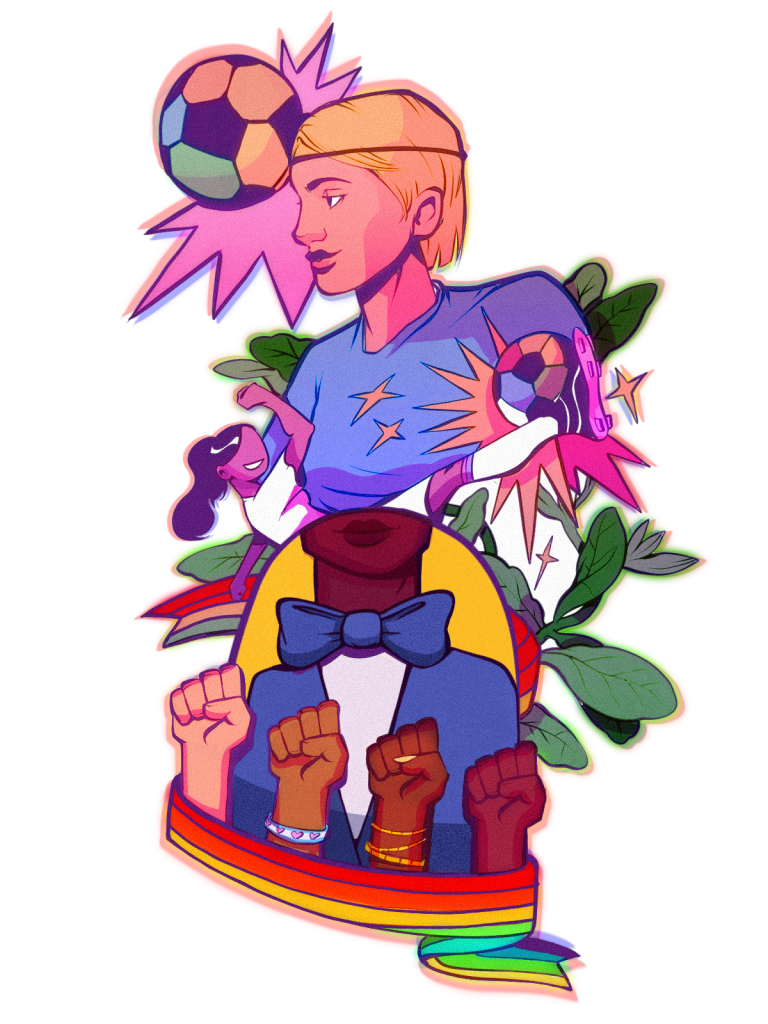
Security at the Madrid Barajas International Airport did not have the technology to detect it at the time, but on July 8th, 2019, an imposter was making her way through the line at baggage screening. She was getting away with a ridiculous crime — an offense that could only be detected on a telepathic level and exclusively punished by a raging inner critic.
I knew this imposter well.
She’s the part of me who comes alive anytime I think of saying “yes” to something that seems way out of my league. That day, it was her clammy palms glomming onto my luggage.
I was flying back from France to New York City after having watched the U.S. win the Women’s World Cup. I was scrolling through my phone when I got an email I was ready to dump into spam. It was from Good Day NY, a morning show on the FOX 5 network:
“Hi Adele – how are you?
I got your info from our Sports Reporter Jennifer Williams. Would you be available to come in as an expert on Wednesday and talk to our anchors live throughout our coverage of the [U.S. Women’s National Team] Championship Parade?”
I froze. My brain spun trying to piece things together because I didn’t remember signing up to cohost a television program! Jen had Tweeted me a month ago about maybe providing a comment or two throughout the tournament and they had never reached out. But this?
Oh no…I don’t think so…
The no-good imposter: I could feel her nervous heart throbbing in my thumbs as they hovered over the keys. She wanted to tell them that Jen got the wrong Adele. That the woman who sings about heartbreak and setting rain on fire would be a better pick. At least she’s used to live TV.
But someone like me? Hello! I’m no sports broadcaster. I hide behind pens and editors for a reason. Ask me about tactics or any legal details about equal pay in real time and I’ll probably say something so dumbbass Twitter would chop me up with a hashtag.
In that case, wouldn’t they rather at least be dazzled by a star? By someone or by people with bling so bright and hair gel so shiny they could only be from the cast of Jersey Shore?
In part, “yes.”
Two days after I received that email, my now-wife, Magdalene, and I were sitting backstage at FOX 5’s NYC studios with DJ Pauly D, JWoww and the rest of the crew. I found it ironic that I was in the same room with the people who taught America how to identify a grenade (nope, not what you’re thinking) when I felt like I was about to bomb.
I watched each of them primp up before their segment on the upcoming season of Jersey Shore Family Vacation as I nommed a bagel and sweated insecurity out my armpits. Once they went, it meant I was next.
Besides my cinnamon raisin delight, there were four things that were anchoring me in this moment:
- My navy blue bowtie. My only bowtie. My loving tribute to my fluid masculinity;
- My bright yellow nails that reminded me of sweet summer lemonades and Beyoncé;
- Magdalene’s soft, warm hands that guided me to get the manicure in the first place, and that took off work that morning to hold me, tether me to this earth; and
- A white man by the name of Glenn Brooks.
Thank God for Glenn Brooks (you go, Glenn Brooks!) for he was also going to be a guest commentator with me, and that meant I wasn’t alone. And Glenn was a pro: a radio show host for New York City Football Club (NYCFC), and not to mention Carli Lloyd’s former college coach at Rutgers. In fact, we were surprised when we realized he was still coaching the Scarlet Knights when I played against them for Yale. It was a 0-1 loss that had me grumbling for days.
Oh, Glenn remembered that goal alright. That damn curveball that floated over my fingers and into the net just minutes before the final whistle. A snide smirk crawled across his face as he recalled. I wanted to smack it off and then etch it in stone because somehow it told me: “Relax, kid. You belong.”
Soon, an assistant called for us to follow them to the stage. I sat in my chair at a long table labeled “Parade of Champions” in navy and gold, which oddly matched my outfit. Hosts Rosanna and Lori sat to my right and smiled at me, already glowing for showtime, already expecting the best. 1. 2. 3. And we were LIVE!
The lights were bright and my face was hot. Brown. Incapable of showing blush or the rush of “why me’s?’ still running in my head. It wasn’t until Rosanna and Lori began asking me questions that things became really clear. My reason for being in that seat.
These TV people didn’t want me there to be an analyst like Julie Foudy — that was Glenn’s role. I was there to be me: A human navigating the nuances of sport and identity. Why couldn’t I see that? Why was it so hard for me to settle into my skin and get comfortable being acknowledged?
I think Rosanna began to tug that answer out of me with this question:
“Adele, I know that personally this team means something to you,” she said. “What does [this parade] mean to you?”
In that moment, I only had the time and the level of consciousness to toss her a nutshell, but here I crack it open to show you the heart.
I am a queer woman who didn’t understand she was anything other than straight until she was 21. I grew up in schools and team cultures where there were few gay women. All of them were made fun of, ridiculed, and bullied. I ingrained these ideas that being different in this way was unsafe, un-Black, contra-Caribbean, and potentially a sign of a psychological disorder. In a paradoxical contortion of self-preservation, I had to reject myself before I even knew who I was. Subconsciously, I could not allow myself to see me, let alone be seen by others.
It was safer to be herd than to be heard.
Perhaps that began to change around the time I started following U.S. Soccer’s Studio 90 on YouTube. I loved watching the behind-the-scenes interviews with the players and watching their antics on the road. Back then, no one was talking about their sexuality, being “out,” or anything. But these players were laugh-out-loud silly and so real. I mean they somehow made shopping at souvenir shops one of the funniest things ever. Either that or I’m an easy laugh.
Regardless, there was something so free about the players, particularly Megan Rapinoe and Lori Lindsey, that really drew me in. I wanted to feel more like them and as I leaned more into that space, I discovered who I was in various aspects of my life. At some point, I began to feel more secure in that being. Proud of it.
At the same time, more and more women athletes were gaining prominence, “coming out,” sharing their culture, their identity, their uniqueness, their politics. I fell into sports journalism and started writing stories about athletes of all genders living their truths. I loved my work and the people I met.
I now believe that my job was a natural extension of this liberation that was blossoming within, setting roots without and reigning me, even if by a thread, to kin who are finding ways to thrive at the edges of society’s norms.
And eventually, at 28 years of age, I arrived in front of a camera wearing my suit and bowtie to be broadcasted to thousands of people all over the world — broadcasted so far that even my future brother-in-law stationed in Afghanistan was watching.
This could’ve happened for any other reason. But part of me couldn’t help but think that if those 23 unapologetically determined, loudly unique women, didn’t come together and amplify each other to achieve such success not just in their sport but culturally and politically…if that didn’t happen, oh-so-queer me wouldn’t have been on daytime TV, chatting it up with Rosanna and Lori.
When I left FOX 5’s studios, I texted Jen thanking her for the opportunity. She received the thanks with a bit of surprise because she never submitted my name to be one of the hosts — at least not intentionally. During the show, she was reporting live from the street and when she heard my voice coming from the studio, she was shocked to hear me speaking.
To this day, this is still a miraculous mystery to me.
There’s no doubt in my mind that when the USWNT won the 2019 World Cup they created a wave not fully understanding whose shores the ripples would lap, shape, and elevate.
So often we talk about successful women athletes being such great role models for young girls everywhere. (“And young boys, too!” is a more recent add-on.) I’ve heard it time and time again, especially after every women’s World Cup I’ve been alive for, because it’s true.
The current success of the USWNT and the successes of the women who came before them have paved the way for many of us. This is so true — and yet, this also makes me yawn.
Because to me it repeats this idea that individual and collective evolution is exclusively linear in this top-down timeline. It’s a narrative that excludes us non-whipper-snappers and has us believing we can’t learn from those whose knees don’t yet creak. It makes kids believe they don’t have anything to share with their elders and that outer authority dictates everything.
If I learned anything from my brief moment on Good Day NY, is that we are all mirrors of each other, and when other people — especially marginalized people — lead from their authentic brilliance, something within invites all of us to remember our truth and expand in it. The effects can be intergenerational, intragenerational, vertically, and laterally within various communities.
If there’s anything I’ve learned from coming out, it’s that my family will never be the same. Hard lessons have been learned; new ways of loving have been discovered. I’ve changed and so have Mom and Dad. Our legacies have been born anew.
When I think about the ways in which we influenced each other at the time — when I really think about what that felt like — I envision a stone plopping into still water creating ripples that concentrically flow away from the center. Or sometimes: a stone flying at a pane of glass, sending cracks in seemingly chaotic directions, not one piece unaffected.
Whether it’s in conflict or harmony I try to ask myself, “If we are all reflections of one another, which parts of ourselves are we teaching each other to love?” We all have a part. We all have a light to shed on something.
I’m tickled by a concept I learned recently from my brilliant friend Dakota (Cody) McCoy, who has a Ph.D. in organismic and evolutionary biology from Harvard. (No big.) It’s called convergent evolution and to explain it simply, this occurs when organisms that are not closely related evolve similar traits to adapt to similar environments or ecological niches.
During her dissertation defense, Cody used the example of the bird of paradise and the peacock spider. The male organisms of both of these species are beautiful creatures with vibrant colors that are impossible to ignore. They use their colors to catch the eye of potential mates during their mating dance.
To better their chances of attracting a lover, both of these species evolved so that their black hairs or feathers surrounding the colorful ones appear blacker than black. On a microscopic level, Cody has found that the structure of each black hair or feather traps more of the sunlight than, say, the cotton of a black t-shirt would, creating an insane contrast with the other colors. So the reason why these creatures are so alluring isn’t because their hair or feathers have more pigment. They’ve created this optical illusion that makes their colors really pop.
Now, with my degree in magazines, I know that when it comes to humans, “evolution” is subjective. It also doesn’t impact everyone in the same way due to socioeconomic, racial, cultural, and gendered reasons (among many other angles of intersection); I know there are many times we regress and that even “regression” can be up to perspective.
But I still hold this fantasy that many of us are learning to trap our own light just like the birds of paradise and the peacock spiders. Not by becoming “more” or changing who we inherently are, but by celebrating together in the wisdom that norms aren’t our North Star.
And what of your shadows, my dear?
The ones that make up the other parts of your universe?
Yes, those.
The so-called “dark” matter that takes up so much space?
-a tremble
As if I didn’t get enough footy in 2019, my World Cup summer came to a close with a trip up to Rhinebeck, NY, to see U.S. soccer legend Abby Wambach and her wife, New York Times–best-selling author Glennon Doyle.
My former coworker, Chris, who knew my passion for the U.S. women’s national team and my at-times-cheesy bent for all things self-help, had just started working at the Omega Institute, where the couple was hosting a weekend workshop called “Find Your Truest Life.” Chris insisted I come.
While I was a bit burnt out from women’s empowerment conferences, I couldn’t say “no” when my colleague graciously offered to let me stay at her house in the beautiful quiet of the Hudson Valley. Plus, I was curious to see Abby play a different role than I’d ever seen: leading primarily from the stage and with the love of her life.
When I got to Omega’s campus, nestled in the woods of Rhinebeck, I felt like I had arrived at an adult hippie summer camp. Cabins dotted the hills as dirt paths snaked through lawns and gardens. Long Pond Lake bloomed a menacing green, telling us it was unsafe to swim due to the toxic algae. Still, we campers had access to basketball and tennis courts, as well as a dining hall that served almond milk and granola.
The amenities and the workshop theme matched my expectations of the other camp-goers: a delightful mix of queer soccer fans and women I’d imagined watched Eat, Pray, Love a number of times. Most of these people were white. In the main hall, I took a seat midway from the stage, both excited and sad — disappointed that people who look like me often don’t get the opportunity or even feel safe and supported in places like this.
Soon Abby and Glennon walked onto the stage and welcomed us with an inspiring word. They told us we were there to do the deep work of unlearning all of the false memos we’ve been given about what it means to be a “good” partner, a “good” woman, a “good” human, and discover what we wanted for ourselves. This was going to be the beginning of living through imagination rather than indoctrination.
I smiled because Abby and Glennon, in all their seriousness, were a fabulous comic duo who could often find the softness in hitting hard topics. Like the sea that foams when it crashes against rock, A and G ebbed and joked; the audience bubbled with laughter. They then put on a poppy P!nk ballad called “I Am Here” and invited us all to dance.
As much as I loved all of this cheese, and as much as I clapped to the tambourine, I was intolerant to some sort of discordance that beat within my chest. This subtle rap, tat-ta-tatting remorse code like:
“I am here
As usual, a minority.
Smiling and joking
My way through that oddity.”
It rapped as I bounced, chuckling and videotaping all of the women without rhythm, eventually noticing that I wasn’t alone. I paused and observed the Black women standing rather still in one of the back rows. I wondered how they were feeling, if they were feeling that dissonance, and whether or not they liked P!nk.
It didn’t feel like the moment to ask.
Early the next morning — before our next gathering — I fell into a more comfortable cadence, sprinting through the trees, cracking twigs beneath my feet, jumping over root and rock, breathing in dew, huffing out thought.
I was running behind Abby on her morning trail run with some other campers. We were “the wolves” chasing some primitive connection — the kind that unearths when you work out in a group.
As we ran in silence, I thought about how amazing it was to be sweating with someone I had to crane my neck to look up to as a kid: one of the highest international goal scorers of all time was now humbled enough to have me at her heels. Or perhaps “inspired” is a better word.
I say that because of what she wrote in her most recent book, Wolfpack:
“Throughout my life, my wolfpack was my soccer team.”
(Wolves working together to win World Cups and Olympic medals.)
“Now my Wolfpack is All Women Everywhere…Women—who are feared by many to be a threat to our system—will become our society’s salvation.”
To her we were like the wolves returning to Yellowstone, rebalancing the ecosystem, snuffing out the patriarchy. But in order to make real change, we had to establish “a collective heartbeat,” she wrote. A unifying structure.
This rhetoric echoed what I’ve heard and read in many spiritual teachings that speak of a “oneness consciousness” that will foster a harmonious world that truly honors diversity.
But which tectonic shifts of mind — of heart — need to happen before the return to Pangea?
Which earthquakes, what rumblings, which reckonings?
For all of us to embody the fact that we are all connected, that “we are all One,” we must first acknowledge how long we’ve been practicing the opposite through body-based discrimination and oppression.
As I ran, I thought about the soil beneath my soles…how in order to move forward I needed to know the present ground below.
In the main hall, the grumble was subtle, ignorable, but palpable if you chose to pay attention: the uncomfortable coughs, the agreeing nods, the shifting in the seats. Some things were stirring, rocking. Processing. Either being broken down or resisting.
Racial justice activist Austin Channing Brown was now on stage — the epicenter. Everyone knew she was going to be one of the guest teachers for the weekend, but I don’t think most signed up for what they were about to hear. If they had read the first sentence of her book, I’m Still Here: Black Dignity in a World Made for Whiteness, would they have been sitting in those seats? “White people are exhausting,” she wrote. When I read that I laughed, recognizing that feeling — the one that I’ve swallowed many times, slightly relieved in a chuckle.
This time Austin, who stood before a room of (basically) white women, didn’t start off with humor but vulnerability. She shared how much energy it took for her to come to Omega. How unsafe she felt sometimes to talk truthfully about race with white people and the risks that come with it.
I was in complete awe of her strength because I’ve known this fear of being labeled “divisive, negative, and toxic,” as Austin has described in her book. I mean, I can’t remember a single time I’ve spoken up against systematic racial oppression out loud in front of a group of white strangers.
(Remember I tend to hide behind pen and paper.)
Instead, I’ve watched my Black friends bring it up and get the following responses:
“I get it. I’m not racist. I don’t even see color.”
(Does that make my pain and that of my ancestors invisible?)
“I know this is so horrible. Sending you love and light.”
(Light also casts shadows. What if the solutions are in the silhouettes? And what if we don’t like it?)
Frankly, we don’t need to. And…
“I don’t need you to like me,” Austin said on stage. “I need you to see the system and be a part of undoing it.”
Austin then talked about allyship and how it’s not just about playing the diversity and inclusion game and getting more Black and Brown bodies in the office. It’s not about being nice and friendly. It starts with acknowledging how years of slavery, colonization, and anti-Blackness have shaped our society’s schools, governments, laws, language. From the words we utter to the Jesus we praise, whiteness is what most of us worship — intentionally and unintentionally. We must unravel all of that if we really want to truly come together in sisterhood.
In other words (my words), that “collective consciousness”, that “collective heartbeat”, that “unity” we are all talking about…none of that can come before the reckoning — and white women especially needed to pick up that mantle.
The audience clapped respectfully. Some women stood up in ovation. I left the room glowing. Hungry. I walked to the cafeteria where I sat with all the Black women eating lunch. We were all energized, electrically connected, like some resistance had been lifted, allowing us to fully be ourselves in this space. There was now enough room to air out our discomfort, as well as more than enough asé coursing through our conversations. We were hopeful about the healing that’s coming for all of our communities and how we each desired to be the ushers of this liberation. I wished I had a mic to record all of what was shared at that roundtable. And I wished I remembered everything that was said.
All I can clearly recall was how the thunder rocked the skies that evening, and me feeling like America’s false gods were upset.
Chundering.
I didn’t see any repercussions coming. But who would look out for them when they are on their way to get their second serving of cereal?
They hurled out — chucked up — during the last supper of the workshop as I was making my way to the frosted flakes. There, I started talking with a white woman who got comfortable enough with me (what is it about me?) to absolve herself of guilt when I was pouring the almond milk. Of all things to make my brain soggy. Of all times for me to freeze.
She told me she didn’t appreciate Austin calling out white women.
Thatshedoessomuchworktohelpkidsofcolor.ShedoesthisandthattospreadloveandAustiniswrongforbeingsoharsh.
Shesagoodpersonandwhydoesn’tshefeelsafearoundme?It’snotfair and…
… for some reason, I could not do anything but listen until high-pitch sounds spilled out of my mouth: “No, no, you’re not a bad person, but you need to understand where Austin is coming from…” I coddled and curdled, leaving that conversation with a sour taste.
Instead of truly advocating for Austin — the woman who inspired me the most — and centering her narrative, instead of advocating for myself, even, who in that moment wanted nothing but to say, “Lady, this is not about your ‘goodness,’” walk away and enjoy a breakfast delight that lately has become my dessert of choice, I left my body and became a mirror of shame.
Ever since then, I’ve been wondering: when will I learn to speak up for my Blackness and the marginalized realities of others in real time? IRL?
Today, it’s a real practice for me.
I understand now that the shrinking, the people-pleasing, the conflict avoidance, the freeze response…all of those are things that have subconsciously protected me (and maybe still do) — have opened doors for me — as a soccer player in prep school, at Yale, in the suburbs, in these white worlds.
But for the most part these habits, this shame, are no longer serving me or the people I love. They are not allowing any of my relationships to grow in authenticity, in truth, in reconciliation. I cannot take responsibility for anything when I’m in this mental space. And yet, when I’m triggered these patterns too often speak for me.
This is an unending.
My reckoning.
My journey will continuously have me revisit, circle back, unpack, and discover my nooks and crannies — the parts I’d rather hide about myself — while embracing them to ultimately say, “Thank you.”
(Yes, I know I’m strange. Queer.)
“Thank you for preserving me when I couldn’t consciously handle it because I’m now ready to change. Thank you for this bitter taste that held my tongue and ushered me to the depths of myself. Thank you for allowing me to type you up on this page even though you’d once fought it, left me speechless, twisted.”
This is the unraveling story of a retired athlete just processing it all — now in love with, still a bit afraid and in awe of the Black that outlines her wholeness.
To get updated on new content, sign up for the email list or follow me on Instagram, Twitter, or Facebook. And consider making a donation! the money goes to support all of the artists and creatives making the magic happen. We so appreciate you <3.
 HERE FOR THE LONG BALL
So beautifully written, Adele. I could feel the awkward discomfort you must have experienced all too often. Here in NZ I feel a similar awkwardness when I go out in society – something I avoid when possible because I am so different from what seems to be acceptable here—stripped of everything I used to identify with and only naked me left. l am looking forward to the next chapter.
LikeLiked by 1 person
I understand the discomfort in awkwardness. I hope you find solace somewhere within. I know it took me forever to respond because I don’t often look at comments, but thank you so much for reading!!
LikeLike